
Disclaimer: I am a Labour Party member and will be voting for Labour in May’s European Elections. This blog is not intended to encourage tactical voting but to explore from an academic perspective whether various parties’ claims to be “the main Remain party” in the upcoming European Elections stand up to scrutiny.
One of the biggest advantages of using a system of Proportional Representation to elect Members of the European Parliament is that it minimises the number of ‘wasted votes’ and reduces the need for tactical voting.
In 1994, the last European Election in the UK to use FPTP, Labour won 71% of MEPs with just 43% of the vote. This compares with 1999, the first to use PR, in which no party won over 50% of MEPs and seven parties were represented in Great Britain, rather than the four represented in 1994. Empirically, far more voters were represented by an MEP they had voted for.
So it may be surprising to see the question of tactical voting arising for the upcoming European Elections, particularly from pro-EU campaigners. This recent tweet caught my attention: https://twitter.com/CllrBobBarr/status/1119851665337745408
There are two main reasons that Remainers are concerned about ‘splitting the vote’ in the upcoming European elections.
The first is the district magnitude of electoral regions. Unlike most other European nations, the UK split its European Elections into regions, each electing a set number of MEPs. This number is the district magnitude. Because the district magnitude is relatively small in each region, it is hard to achieve a proportional result. The North East, for example, elects only three MEPs. If five or six parties are competing there and each gets a sizeable chunk of the vote, there is no way of distributing the seats in a way which gives most people representation
The second reason is the D’Hondt method of allocating MEP seats. This is how it is decided which parties get how many seats, to be proportional. As Wikipedia helpfully explains:
Proportional representation systems aim to allocate seats to parties approximately in proportion to the number of votes received. For example, if a party wins one-third of the votes then it should gain about one-third of the seats. In general, exact proportionality is not possible because these divisions produce fractional numbers of seats. As a result, several methods, of which the D’Hondt method is one, have been devised which ensure that the parties’ seat allocations, which are of whole numbers, are as proportional as possible. Empirical studies show that the D’Hondt method is one of the least proportional among the proportional representation methods. The D’Hondt slightly favours large parties and coalitions over scattered small parties.
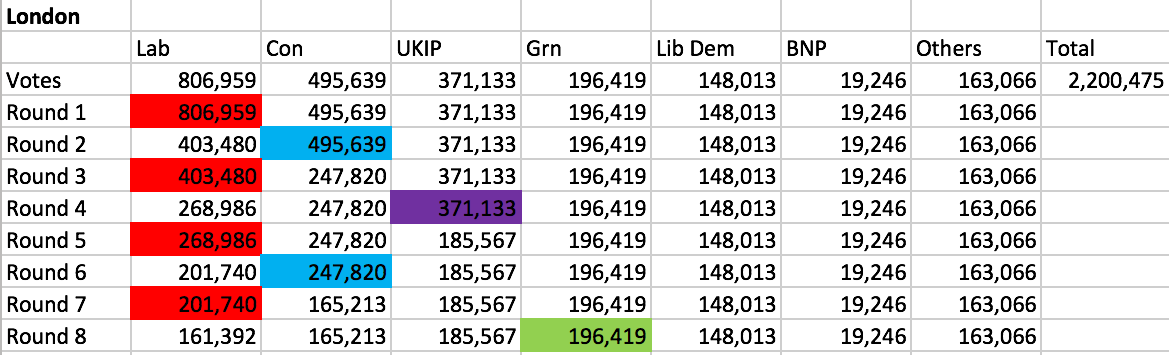
For European elections, this system operates as follows:
- Seats are allocated in successive rounds, with one seat allocated in each round
- At the start of each round, the total votes for each party are divided by the number of seats the party has already won, plus one
- The party with the highest remaining total wins the seat in that round.
Here, for example, is the method applied to London in 2014:
So, to make a contribution to the debate around progressive alliances and tactical voting for the European elections, I decided to look at the number of additional votes required for ‘progressive’ parties (Lab, Grn, Lib Dem, SNP, Plaid) to gain seats, particularly at the expense of UKIP and the Conservatives.
It could be argued that the political situation has changed to the point that the 2014 results are a bad guide for the 2019 elections. However, opinion polling for the elections so far has been very inconsistent. Of the polls conducted in April, we’ve seen everything from a Labour lead of 15% to a Brexit Party lead of 5%. The Greens, Lib Dems and Change UK have all been polling closely, generally at just under 10%. This means any one of them could be on course for 7 or 8 MEPs, or none, depending on how the votes split. In terms of deciding anti-Brexit tactical voting, the only reliable evidence we have comes from the 2014 election.
I split the tactical voting into two blocs, a broadly progressive tactical vote including Labour (Lab, Grn, Lib Dem, SNP, Plaid) and more hard-line pro-EU bloc without Labour (Grn, Lib Dem, Plaid, SNP). For the purposes of this exercise, I have excluded Change UK, who will invariably mess up any tactical considerations for Remainers!
The two maps below show who in each region has the best chance of gaining a seat, not at the expense of another party in each bloc.
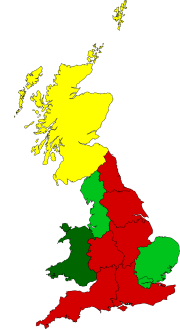

Due to the nature of the PR system, it is very hard to calculate how to best vote tactically. In most cases, the Lib Dems and Greens are relatively close in vote share, so it is not worth voting tactically between them. In a few regions, Labour is closest to picking up another MEP off of UKIP or the Conservatives.
It is also worth noting that these are based simply on the number of votes each party would need to gain to win an additional MEP, it does not take into consideration variation in the vote share of UKIP or the Conservatives. Despite this, it is still an indicator of how close these parties are to gaining an MEP in each region.
The results for each region are summarised below. As you can see, regions where the Conservatives or UKIP were awarded the final seat last time were pretty easy to work out. It is just the number of additional votes to unseat them plus one, where a party does not already have any MEPs, or the number of additional votes needed multiplied by the number of MEPs (plus one) that party already has, plus one.
The second type is a bit more complicated so here is the East Midlands as an example. Working out the votes needed by the Greens and Lib Dems is easy, it is just the number of votes that the Conservatives have in the final round (145,635) minus the Green or Lib Dem totals (67,066 or 60,772) plus one, giving 78,570 and 84,864 respectively.
To work out the figure for Labour, which already has an elected MEP in the East Midlands, we find the difference between the final round Conservative vote (145,635) and Labour vote (139,682), which is 5,953. Multiply it by the number of Labour MEPs already elected plus one (two) and add one. This gives 11,907, so in the East Midlands, the most efficient route from the 2014 result to kicking out one Conservative or UKIP MEP is for 11,907 additional people to vote Labour.

Summary of Regions
Party – Additional Votes Needed to Unseat UKIP or Con – Additional Votes Needed to Unseat UKIP, Con or Lab
East of England
- Green – 15,526 (Con) – 15,526 (Con)
- Labour – 26,113 (Con) – NA
- Lib Dem – 40,847 (Con) – 40,847 (Con)
East Midlands
- Labour – 11,907 (Con) – NA
- Green – 78,570 (Con) – 78,570 (Con)
- Lib Dem – 84,864 (Con) – 84,864 (Con)
London
- Green – 547,041 (Con) – 207,062 (Lab)
- Lib Dem – 595,447 (Con) – 255,468 (Lab)
- Labour – 679,962 (Con) – NA
North East
- Labour – 310,993 (UKIP) – NA
- Lib Dem – 319,227 (UKIP) – 74,902 (Lab)
- Green – 323,716 (UKIP) – 79,390 (Lab)
North West
- Green – 37,570 (UKIP) – 37,570 (UKIP)
- Labour – 48,514 (UKIP) – NA
- Lib Dem – 55,158 (UKIP) – 55,158 (UKIP)
Scotland
- SNP – 32,101 (UKIP) – 32,101 (UKIP)
- Green – 32,229 (UKIP) – 32,229 (UKIP)
- Lib Dem – 45,215 (UKIP) – 45,215 (UKIP)
- Labour – 73,384 (UKIP) – NA
South East
- Labour – 32,946 (UKIP) – NA
- Green – 164,015 (UKIP) – 164,015 (UKIP)
- Lib Dem – 187,845 (UKIP) – 187,845 (UKIP)
South West
- Labour – 443,604 (Con) – NA
- Green – 483,281 (Con) – 245,801 (Labour)
- Lib Dem – 489,352 (Con) – 251,872 (Labour)
Wales
- Plaid – 143,621 (Con) – 143,621 (Con)
- Labour – 176,895 (Con) – NA
- Green – 222,210 (Con) – 222,210 (Con)
- Lib Dem – 226,555 (Con) – 226,555 (Con)
West Midlands
- Labour – 64,979 (UKIP) – NA
- Lib Dem – 67,023 (UKIP) – 67,023 (UKIP)
- Green – 71,207 (UKIP) – 71,207 (UKIP)
Yorkshire and Humber
- Labour – 23,442 (UKIP) – NA
- Green – 32,262 (UKIP) – 32,262 (UKIP)
- Lib Dem – 53,435 (UKIP) – 53,435 (UKIP)


 Owen Winter
Leave a reply to tomfryer2 Cancel reply