Donald Trump’s Support Among Young People Hits Rock Bottom – Newsweek
- Owen Winter, a political data journalist for The Economist, wrote on X: “Donald Trump’s approval rating in our tracker has fallen to -18, the lowest it has ever been (lower than any point in his first term).”
A City we can afford”: capitalism and democracy in New York – Adam Tooze’s Chartbook
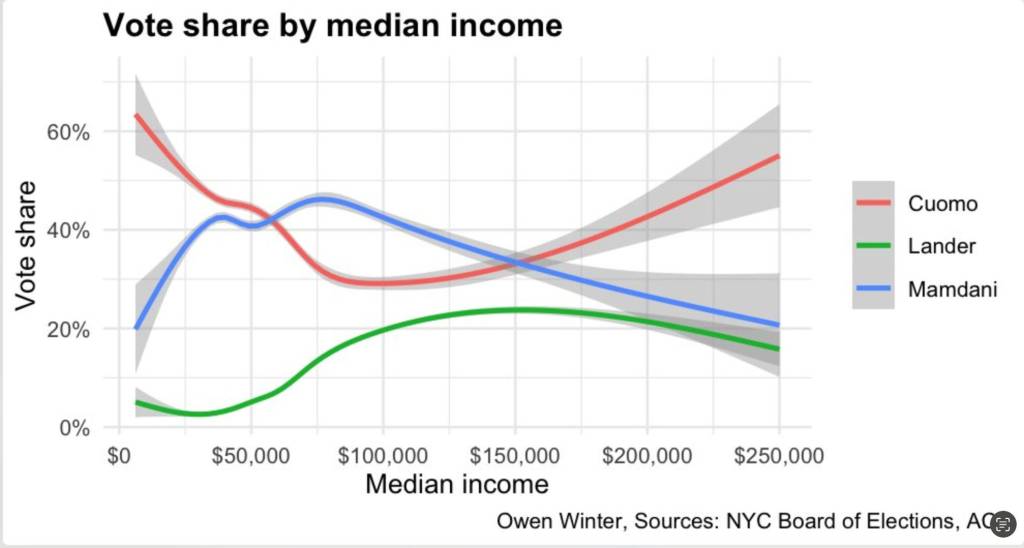
- It does seem clear that Mamdani has rallied a new coalition that is heaviest in the “middle-income band”, which in NYC can be reasonably said to stretch from $60,000 to $150,000.
Zohran Mamdani’s primary win and the Democrats’ Tea Party moment – NPR “It’s been a minute” podcast
- I also saw a graph by Owen Winter, a political data journalist at the Economist, that showed areas with a higher percentage of millennials went for Mamdani across all races, but Black millennials especially. So I wonder – what is the image of a progressive voter, and how does that stack up to how things shook out in this race?
Mamdani, Trump and the End of the Old Politics – The Ezra Klein Show
- What did you make of the strange structure of the coalitions?
- I don’t really have a good theory on it yet. The one piece of election analysis that has stuck out the most to me is this triangle that breaks down precincts by their degree of racial integration. Have you seen this triangle? It’s so fascinating. It breaks down precincts by how white they are, how Black they are or how “other” they are. This is by census — these are not the racial categories that I would use to describe people. Basically, what it finds is that the precincts that are all Black and all white were Cuomo precincts. And the more mixed a neighborhood was in its racial makeup, the better Mamdani did. Which I find to be a fascinating result. Now that might just be a proxy for the income stuff you’re talking about.
Making sense of Mamdani – The Free Press
- Drawing on precinct-level data, Owen Winter of The Economist observes that Mamdani fared best in neighborhoods with a median household income between $75,000 and $200,000. Andrew Cuomo, in contrast, crushed Mamdani in lower-income neighborhoods and edged him out in richer ones.
The Democrats’ generational rift just got harder to ignore – The Washington Post Opinion
- When votes were tallied on Tuesday, we saw not only that Mamdani was victorious but that it was younger voters who helped propel that victory. There was a correlation between the median age in a state assembly district in the city and the margin of support for Mamdani and Cuomo, with the socialist faring better in places that skewed younger. The Economist’s Owen Winter explicitly attributed Mamdani’s win to the city’s millennials, only partly exaggerating what the data showed.
Why Is TikTok Such Rocket Fuel For Populists? – Ian Leslie – May 2025
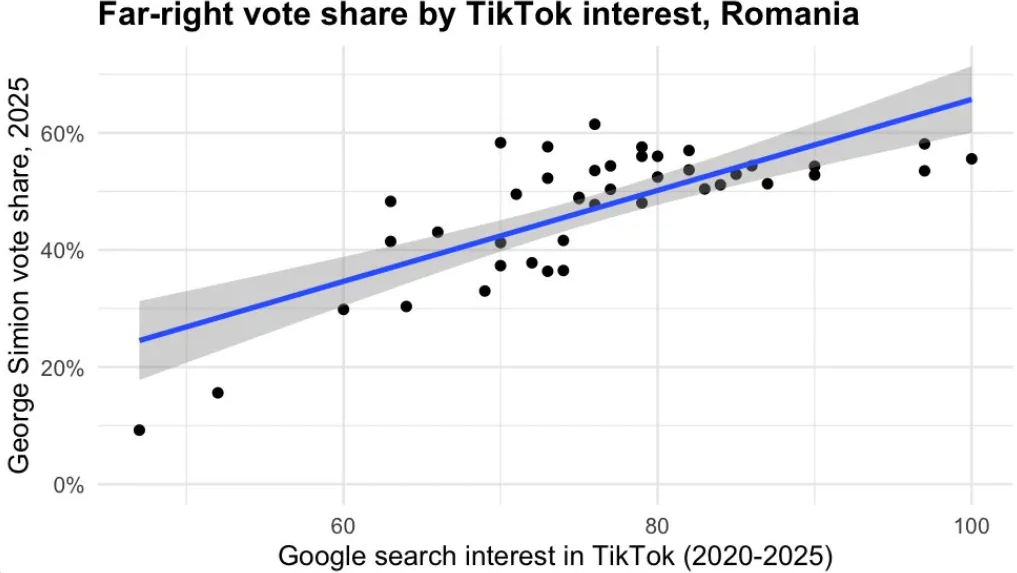
- The second is this graph, courtesy of the Economist’s Owen Winter:
The Crunch: Trump takes egg (and stock prices), the data on disasters and a meandering cyclone – The Guardian – April 2025
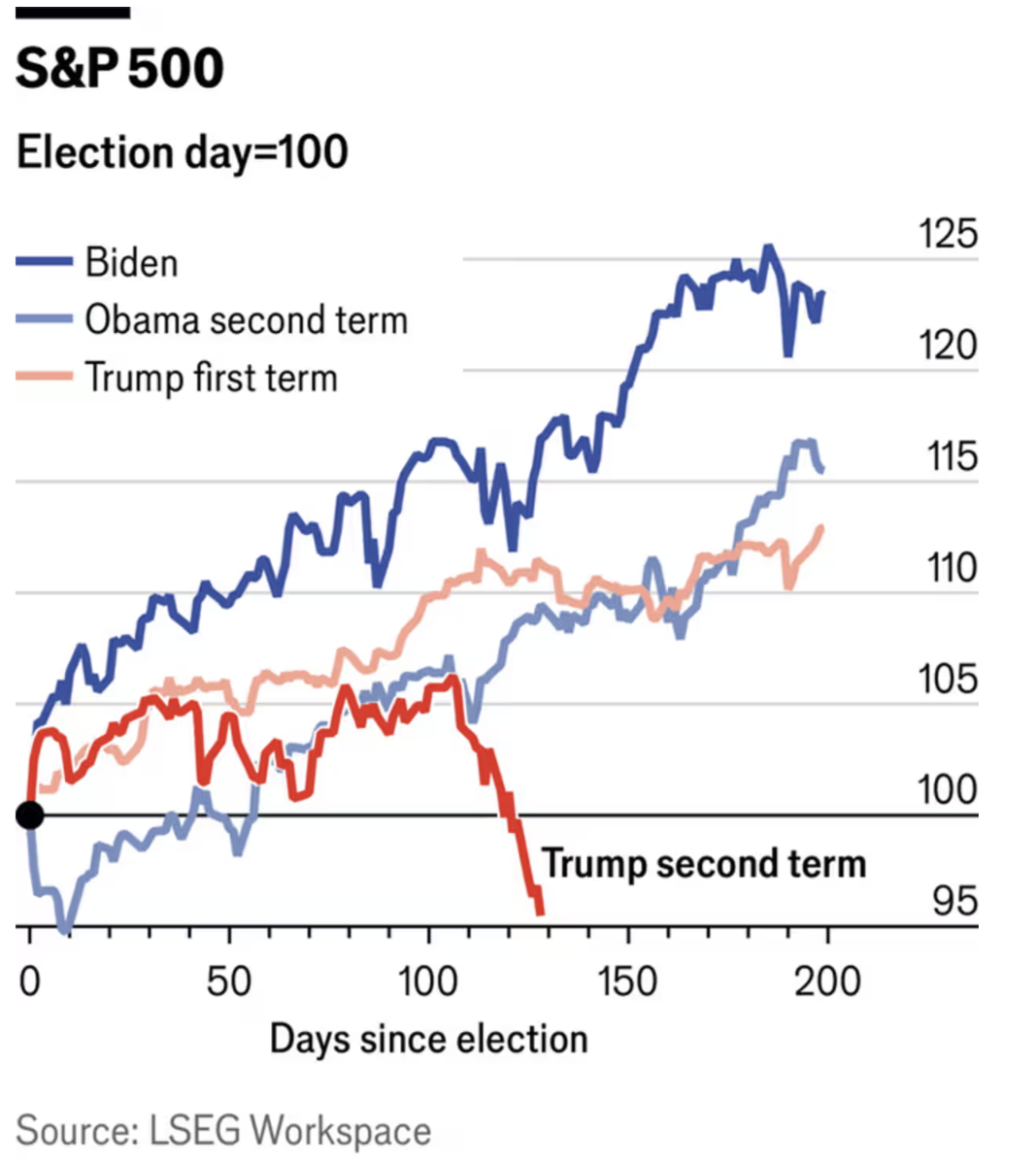
- The earliest version of the chart format I could find was by Owen Winter from the Economist, who has been updating the chart since at least 4 March. His latest predates the “liberation day” tariffs announcement though – the plunge continues.
Gen Z, democracy and a problem with the speech from Channel 4’s Chief Exec – The Week in Polls – February 2025
- A similar point about the high quality BES data painting a different picture was made by Owen Winter. Given the high quality and easy availability of the BES data it is not clear why it did not make it into the Channel 4 or Craft footnotes, particularly when it provides a time series and several of the sources cited do not.
Are the new Parliamentary seat projections worth paying attention to? – The Week in Polls – January 2025
- “Or as polling expert for The Economist Owen Winter put it: More in Common’s MRP has the predictable mid-term attenuation, hurting the Lib Dems and Greens most of all. In other words: Lib Dem MPs will surely outperform mid-term MRPs after dropping a kajillion leaflets during an election campaign.”
Dire polling exposes the emptiness of Labour’s mythic plan – The National – September 2024
- “To put that in perspective, The Economist’s political data scientist, Owen Winter, compared the polling average to other prime ministers. It took John Major 397 days before plummeting below 30 points in the polling, and that was after 14 years of Tory rule. Harold Wilson took 664 days to suffer the same fate, the hideously embattled Theresa May took 664 days, while Tony Blair took 1104 days after his 1997 Labour landside. It has taken Keir Starmer’s Labour just 70 days.”
Both Labour and group of Conservative MPs say Lee Anderson defection highlights Tory failings – as it happened – The Guardian – March 2024
- “Owen Winter from the Economist points out that, when Lee Anderson seeks reelection as a Reform UK candidate in Ashfield, he will be up against not just the main parties, but also Jason Zadrozny, a local independent who came second last time.”
Reform UK rises up poll ratings but are its supporters real? – Financial Times – January 2024
- “Owen Winter, of Stack Data Strategy, has done some interesting analysis of the impact of weighting a survey before vs after excluding “don’t knows”: removing them could be exaggerating Labour’s poll lead.”
Some polling you should ignore: Telegraph/YouGov, round 2 – The Week in Polls – January 2024
- (paywalled) “An update on that Owen Winter graph this newsletter loves: Labour’s lead in the polls is (perhaps fleetingly) larger than at the same point in the run-up to the 1997 general election.”
What’s the reality behind the big Daily Telegraph/MRP story of the week? – The Week in Polls – January 2024
- “Another big brain, Owen Winter, has research showing how there is a cyclical pattern at work, with the vote shares for parties smoother mid-Parliament and then getting lumpier (i.e. more concentrated in some seats and more squeezed down in others) as an election nears.”
Labour, the Unions and Proportional Representation – The Political Quarterly – January 2024
- “Owen Winter was a sixteen year old school student at the time of the 2015 general election. In that election, the Conservatives won an overall majority on under 40 percent of the popular vote. Dismayed, Winter created a petition on change.org, calling for the voting system to be changed.”
Does the Israel-Gaza war create problems for Labour with Muslim voters? – UK in a Changing Europe – November 2023
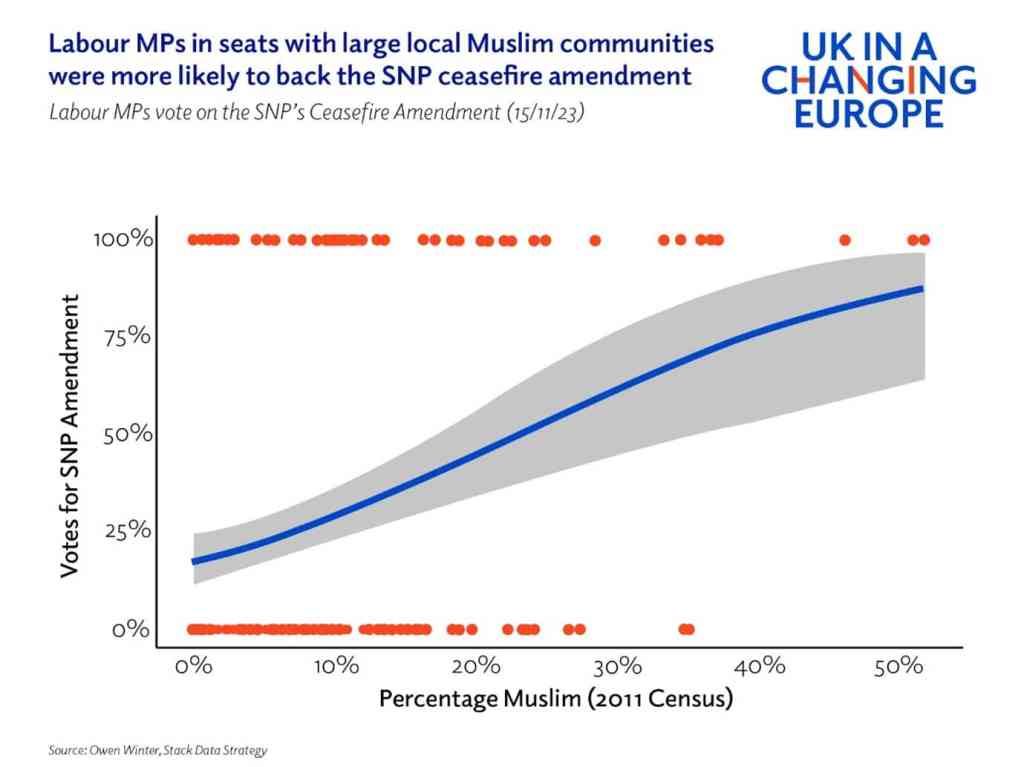
- “Analysis by Owen Winter of Stack Data has shown that both Muslim MPs and those representing seats with a big Muslim community were significantly more likely to vote for the SNP ceasefire amendment.”
What the ceasefire vote means for the future of the Labour party – The Spectator – November 2023
- “An analysis by Owen Winter of Stack Data Strategy found ‘a pretty striking relationship’ between the percentage of Muslim voters in a constituency and the likelihood of a Labour MP voting against Starmer on Gaza last night.”
Rishi’s Rwanda Plan B – Politico – November 2023
- “Polling geek Owen Winter also plotted a chart suggesting Labour MPs with a large Muslim population in their seat were more likely to back the amendment.”
The impact of local identities on voting behaviour: a Scouse case study – British Politics – September 2023
- “One study, by Winter (2023), does attempt to explore the political and attitudinal profile of Cornwall. Using a technique called coarsened exact matching (Iacus et al. 2012), Winter isolates the effect of living in Cornwall (relative to living in the rest of England) on 18 political variables. He finds that those living in Cornwall are more likely to support the Liberal Democrats—reflecting the Liberal Party’s historic strength on the ‘Celtic fringes’—and have lower trust in the Westminster government (although this is linked to disproportionately lower levels of Conservative Party support, the governing party at the time). There is also higher support for protecting the environment and for the Green Party, as well as being economically left-wing. Interestingly, people in Cornwall are not less likely to define themselves as English or British despite the existence of the Cornish identity, a point which is supported by Willett (2008), who finds that the Cornish identity can and does co-exist with the English identity.”
Will Truss’s Time end in Failure? Assessing the Prospects of the latest ‘Takeover’ Prime Minister – Political Quarterly – October 2022
How the UK’s electoral system holds back green groups – Financial Times – February 2023
- “Owen Winter, co-founder of non-partisan electoral reform advocacy group Make Votes Matter, which campaigns for the UK to adopt proportional representation, points to research by the University of Michigan into the breadth of debate on policy under proportional voting systems: “When there are more political parties represented, there’s broader political debate [and] climate issues tend to rise up the agenda,” he explains. “This feeds through into public opinion and ultimately into policy outcomes.” Winter also suggests that governments elected by proportional representation tend to take a longer term view of policy, which is important for climate initiatives.”
Brexit continua a dividere a cinque anni dal referendum – Domani – June 2021
- “«Tra le nuove generazioni, in molti sono rimasti frastornati dagli ondeggiamenti del Labour, e hanno preferito magari appoggiare i Verdi», dice Owen Winter, che è esperto di dati e politica e ha fondato ‘Make Votes Matter’.”
 Owen Winter