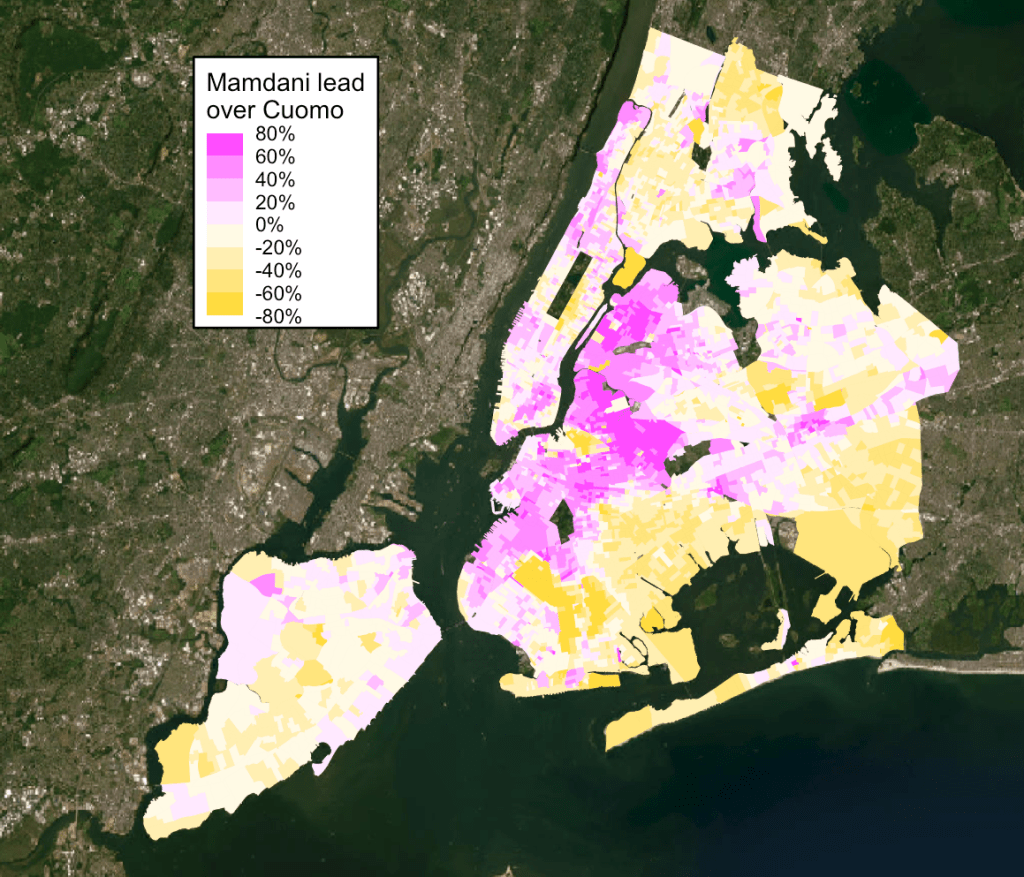
My housemate says Zohran Mamdani has been living in my head rent-free (she thinks he’d approve). I’ve been pouring through precinct results since the young socialist defeated former governor Andrew Cuomo to become the Democratic candidate for Mayor of New York City. Mamdani far outperformed pre-election polls to win 44% of first preference votes to Cuomo’s 36%. The final round tallies haven’t been published yet but Mamdani is likely to win a majority of third-placed Brad Lander’s second preferences (Lander and Mamdani cross-endorsed each other).
The primary has some interesting implications for Democratic politics in Trump II. Mamdani is aligned with the AOC-Bernie Sanders wing of the Democratic Party. The fact he could win the Democratic nomination in America’s largest and most diverse city is significant (Sanders lost New York City by 27 points in 2016). Although it looks as though Mamdani underperformed among Black voters—as polls suggested he would—he did much better than expected among Hispanic and other non-white voters, who have previously supported establishment Democrats.
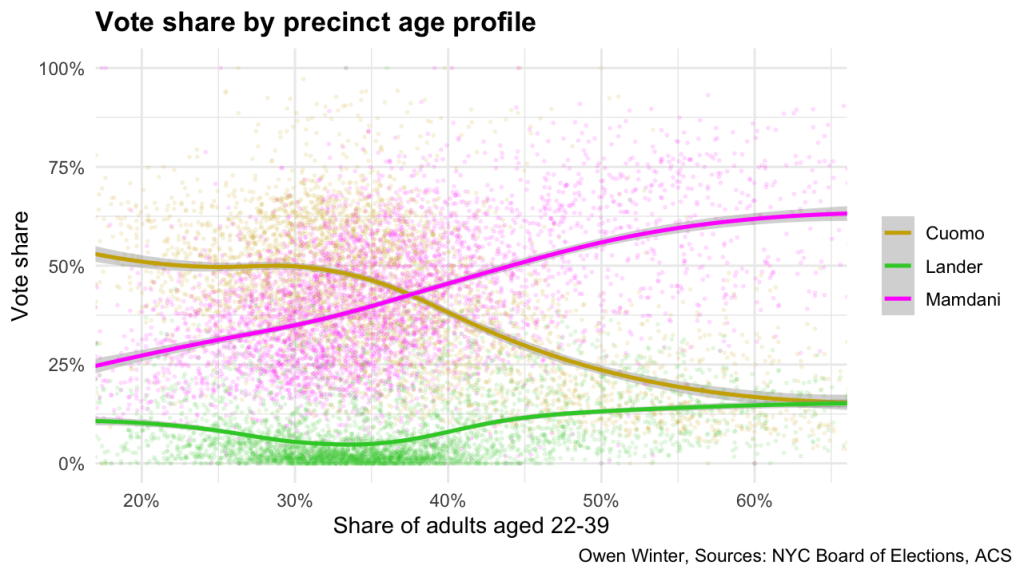
The most striking demographic cleavage in precinct-level results is age*. Perhaps unsurprisingly, Mamdani did best in precincts where residents aged 22-39 formed the largest share of adults, while Cuomo won areas with older populations (and the few precincts with a large population of 18-21 year olds). Turnout data suggests many of these were new or infrequent voters, who Mamdani targeted.
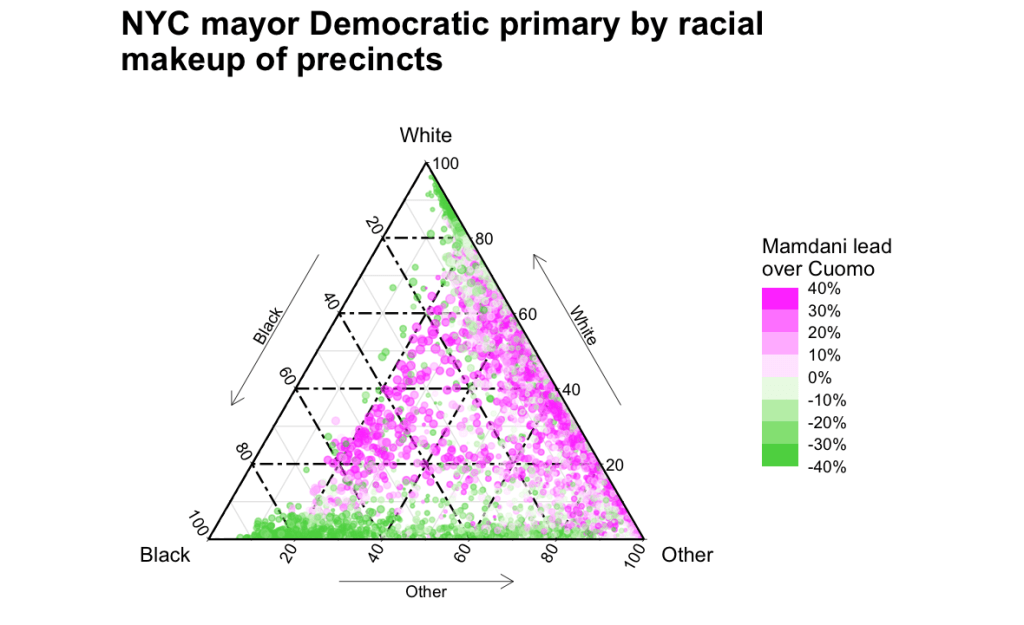
As expected, Cuomo performed best in Black-majority neighbourhoods. The chart below shows how he won most precincts with over 80% Black residents. Cuomo also performed well in precincts which are over 80% White, while struggling in more mixed neighbourhoods, or those with a large number of Asian or Hispanic residents.
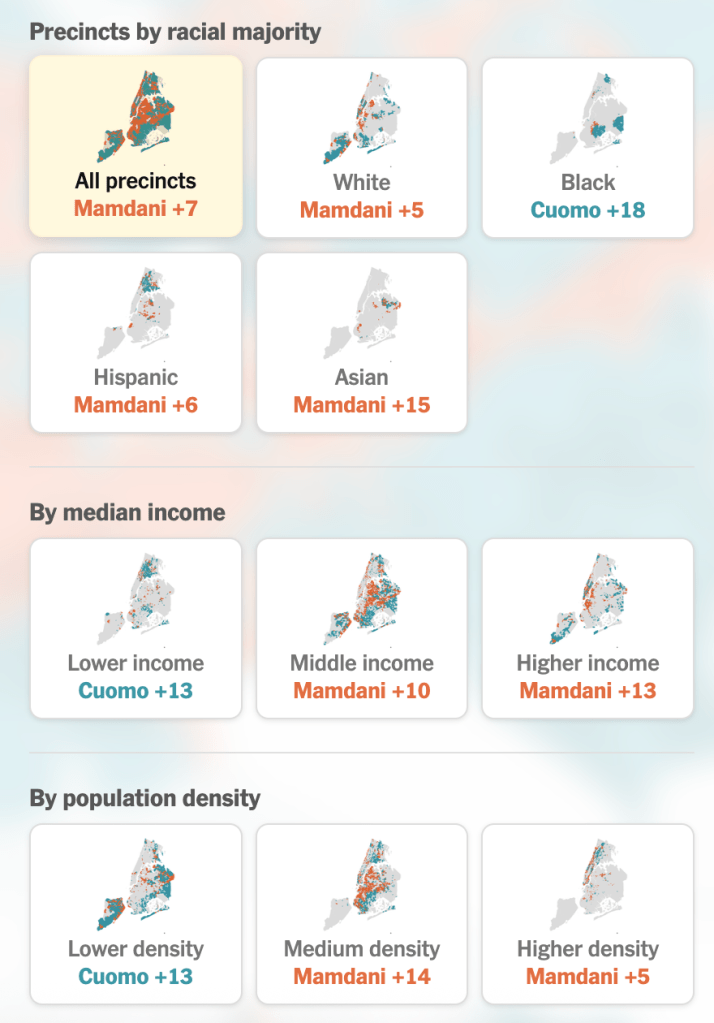
These numbers should be taken with a pinch of salt. In a diverse, mixed city like New York, ecological inference could be misleading. The NYT had a nice graphic (below) showing the results split by precinct characteristics. But with such high multicollinearity, it would be a mistake to interpret these as representative of the individuals of each demographic.
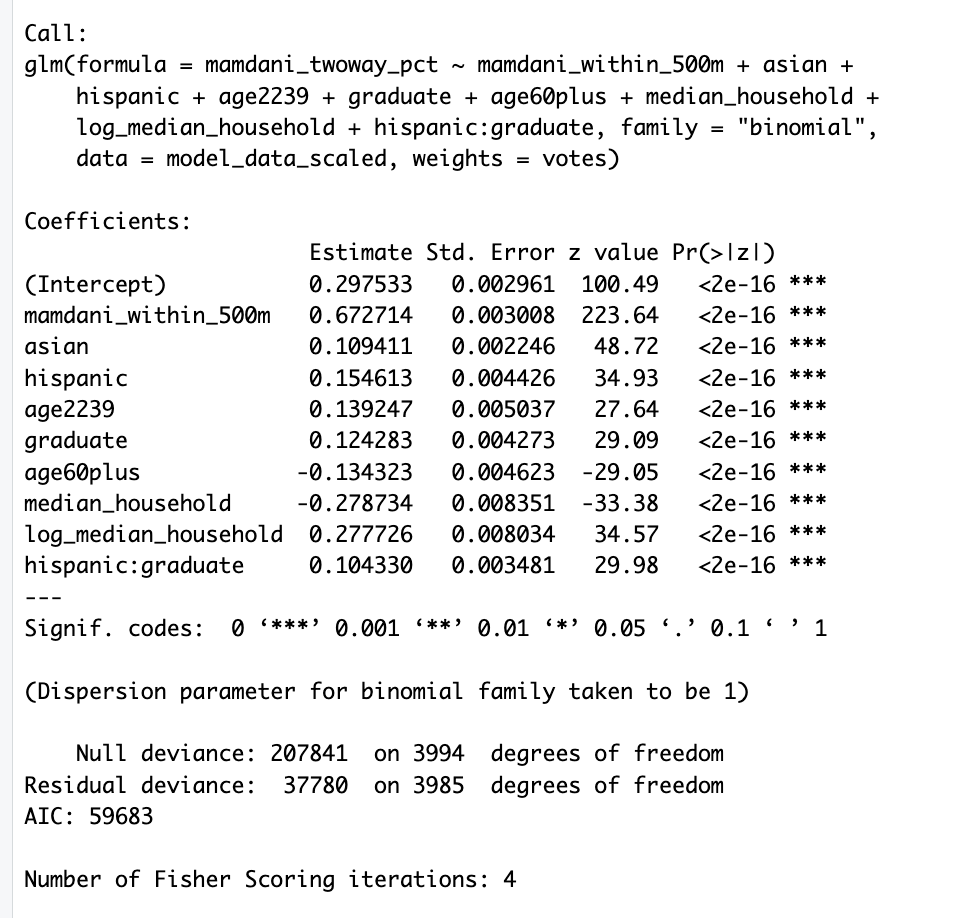
To analyse the results in more depth, I fit a spatial lag regression model, with each precinct’s two-way results (i.e. Mamdani vs Cuomo) predicted by the results of nearby precincts (within 500m), along with demographic characteristics. Similar to a difference-in-difference model, this allows us to measure the effects of demographics after having controlled for neighbourhood effects. For interpretability, I reduced the size of the regression with a stepwise function to see just the most influential variables.
Age
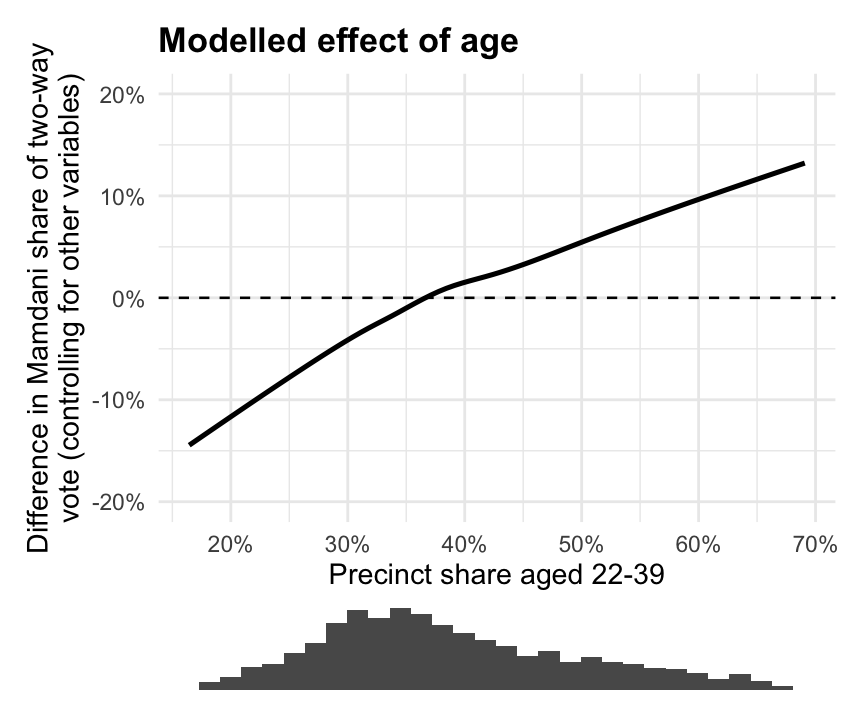
As expected, the model showed Mamdani did best in areas with the largest population of 22-39 year olds and the smallest populations of those aged 60 plus, all else held equal. On average, this meant Mamdani had a 25pt larger share of the two-way vote in precincts with most 22-39 year olds.
Income
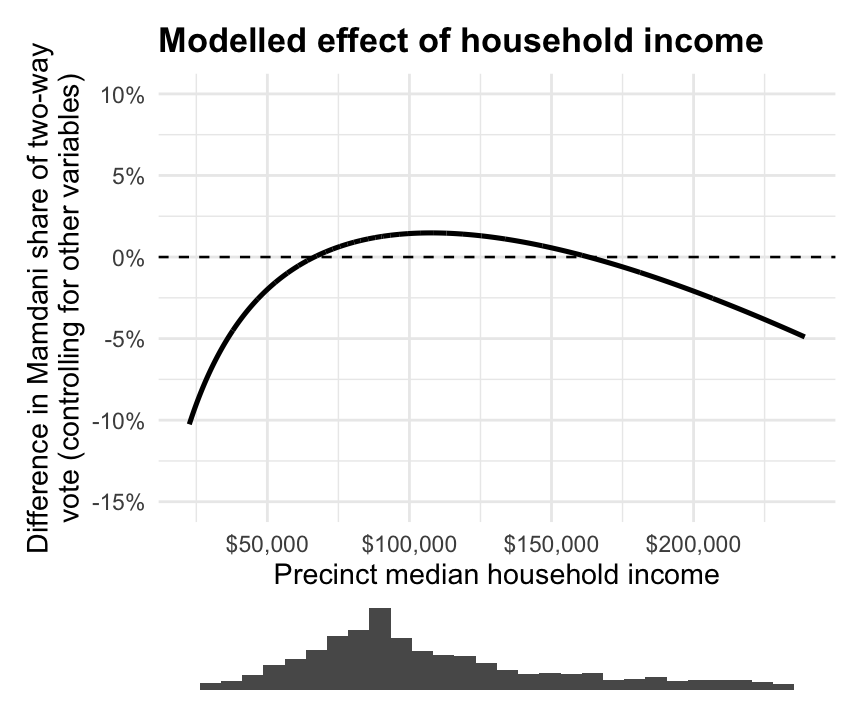
The regression showed that median household income was another strong predictor of voting habits, albeit with non-linear effect. Cuomo’s vote was strongest among the poorest (which explains some of his over-performance in predominantly Black neighbourhoods) and very richest precincts. By percentile, this means the effect of income was positive for Cuomo in approximately the poorest 15% of precincts and the richest 15%, while Mamdani did relatively better in the middle 70%.
Race
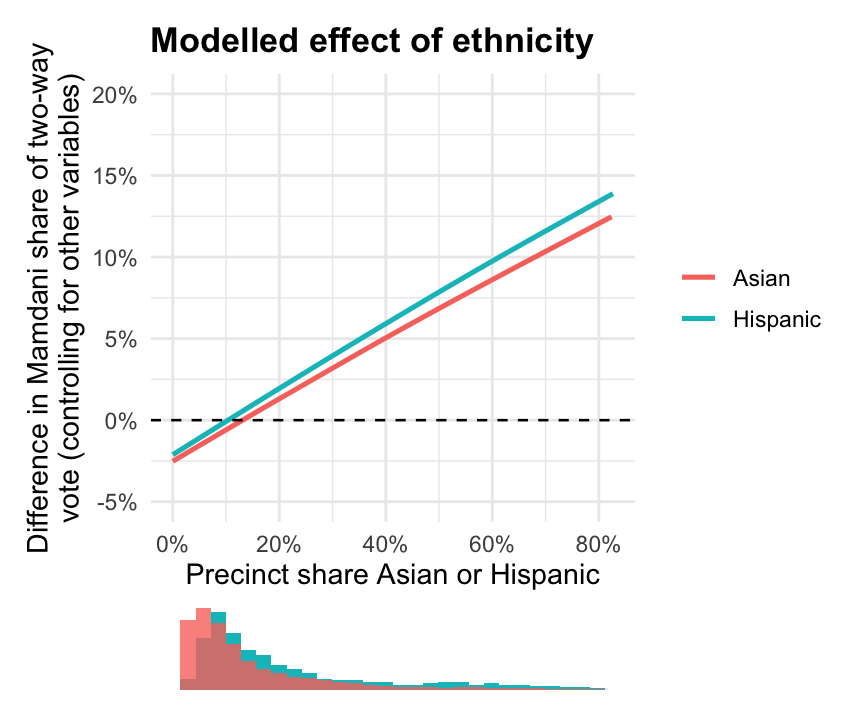
After age and income, the regression found that Mamdani performed substantially better in precincts with larger Asian or Hispanic populations. Mamdani’s performance with these communities was one of the surprises of the election, with pre-election polls suggesting that his support was mostly confined to White voters. After accounting for income, age and education, the model did not find that the Black or White share of population were among the most predictive features.
Graduates
Finally, the regression showed that educational attainment was a significant factor in the election. Mamdani did best in areas with more university graduates (especially those with a high number of graduates as well as a high number of Hispanic residents). These areas also tended to have much higher turnout.

Victory for the Democrats’ left wing
Winning a primary is not the same as winning an election (Mamdani may still go on to lose the general election) and New York City is not representative of America. But Mamdani’s victory could be a sign that the balance of power is moving towards progressives in the Democratic Party, after a series of defeats since 2020.
Despite being a liberal city, New York’s Democratic primary voters tend to be more moderate than Democrats nationwide. The city’s Democratic voters backed Hillary Clinton over Bernie Sanders by 27 points in 2016, with strong support from Black and Hispanic voters. If progressives have broadened their appeal in 2025, it could be a good sign for their fortunes in the Democratic Party as a whole.
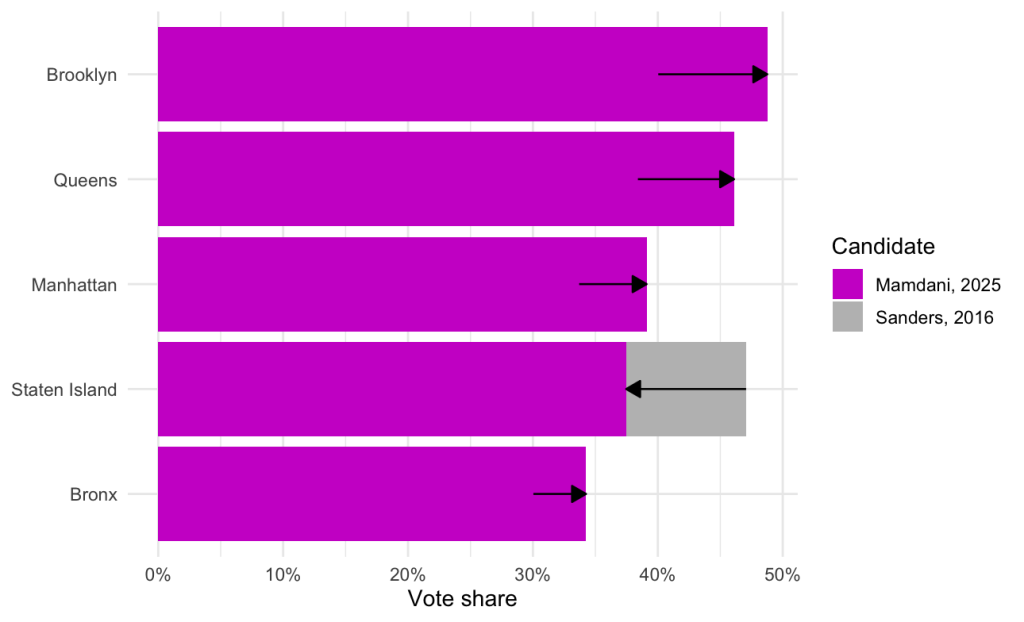
That said, progressives will not usually have the good fortune of running against a candidate as cartoonishly bad as Andrew Cuomo. The lesson of the primary might just be that telegenic outsiders can beat scandal-plagued insiders, even if party elites don’t like it.
* Demographic data here is from the Census and ACS. In some cases, census blocks, block groups or tracts did not match perfectly to election precincts. I chose the matchup which fit best but for some precincts the demographic data will not match perfectly.



Leave a Reply