Suella Braverman‘s recent resignation and reappointment has exposed the divides within the Conservative Party over immigration. Some, including former Prime Minister Liz Truss, believe growth should be prioritised over reducing immigration. Others, including Braverman, believe reducing immigration should be a top priority.
This debate is often framed around public opinion. How much immigration are voters ‘willing to accept’ for the benefits to the economy. However, public opinion has shifted significantly in recent years. John Burn-Murdoch has shown how since the EU Referendum the salience of immigration has significantly diverged from the annual rate of immigration. With salience this low, regardless of their preference, the public are likely to accept significantly more immigration than they would have before 2016.
But it is not just salience which has shifted, public opinion of migration has too. Below is data from the British Election Study survey immediately before the EU Referendum and from its most recent survey in May 2022. Here we can see how the number of people saying they would prefer ‘0 – Many Fewer’ immigrants has fallen from 28% to 19%. The number responding 5, indicating a preference for migration to stay at the same level, has risen from 11% to 17%. And the number answering ’10 – Many More’ has gone from 2% to 6%.
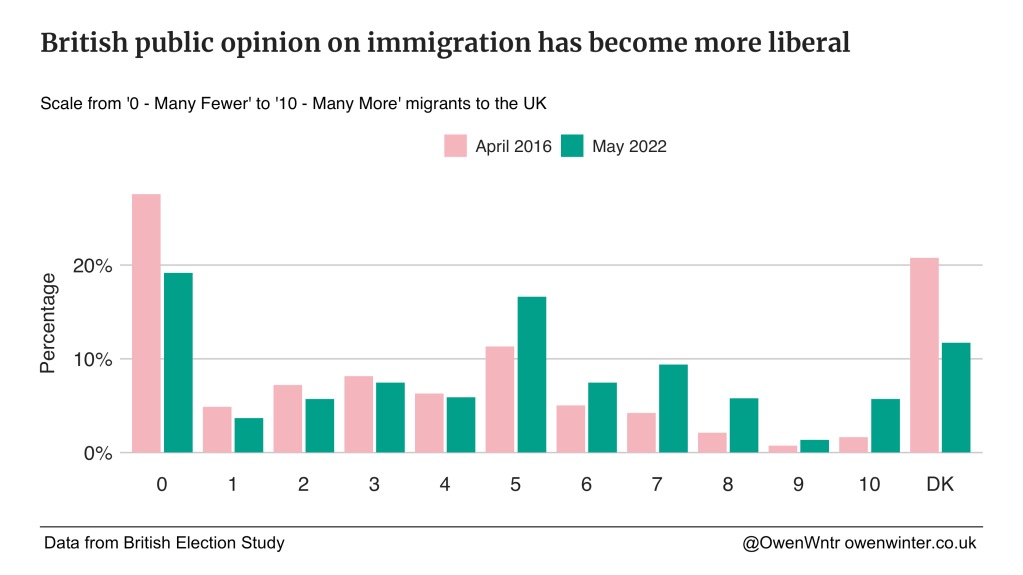
others think that the UK should allow many fewer immigrants. Where would you place yourself and
the parties on this scale?
All together, the public split 42% – 29% in favour of fewer immigrants being allowed to come to the UK in 2022, compared with 54% – 14% in 2016. To be clear, that is still a decisive preference for less migration, but the shift in margin is dramatic. The number answering ‘Don’t Know’ has also fallen, possibly suggesting that the EU Referendum caused views around immigration to crystallise, as people fell into their respective ‘camps’.
These numbers do not account for the geography of public opinion, however. One argument in favour of more stringent migration policy is that pro-immigration sentiment is confined to certain big cities, while more electorally relevant constituencies oppose migration. To get a better sense of this, I modelled responses to the question by Parliamentary Constituency, using multilevel regression and poststratification.
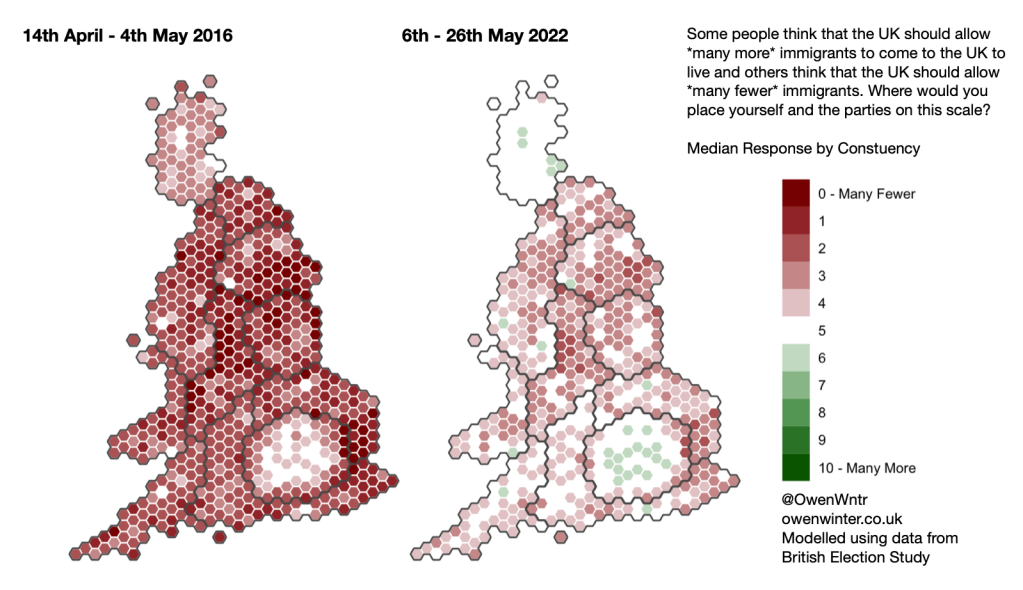
The results here do suggest that constituencies skew towards opposition to migration. In May 2022, the median response in the median constituency was 4, while the median response nationwide was 5. This matches the geographic advantage of the leave vote in 2016, with remain voters and supporters of immigration concentrated in a small number of urban constituencies.
There are 28 constituencies where the median response is 6, preferring slightly higher numbers of immigrants be allowed to come to the UK. 16 of these are in London, 3 are in Edinburgh (East, North and Leith, South), 2 are in Glasgow (Central and North), and the remainder are Brighton Pavilion, Bristol West, Cambridge, Cardiff Central, Liverpool Riverside, Manchester Withington and Sheffield Central.
These results suggest there is little be gained electorally by pushing for higher rates of immigration in itself. But with the salience of immigration being so low (11% named immigration as one of their top 3 issues in August 2022) while salience of economic issues and public services is much higher, there is unlikely to be a strong backlash to a more liberal immigration policy.
If politicians link migration to more salient issues, such as driving economic growth, support may rise even further. For many people, the EU Referendum was the first time they heard politicians directly making a positive case for migration. For a long time, even the most pro-migration politicians pitched it as a necessary evil, hiding behind EU law rather than making the case for open borders. The shift in public opinion since 2016 suggest a more positive case for immigration will not fall on deaf ears.
 Owen Winter
Leave a comment