Scottish independence is often spoken about as if it is an inevitability. Part of the reason for this is the age profile of Scottish nationalists and unionists. Supporters of independence tend to be much younger, so, the logic goes, will eventually outnumber unionists as the population ages.
I’m generally sceptical of arguments about the fates of political movements based on age cohorts alone. While some demographic features might be expected to have a fairly predictable effect, so fluctuations in size of that group are relevant, age is not one of them. It acts both as a ‘cohort effect’, with certain shared experiences affecting people born in at certain times, and as an ‘age effect’ in itself, with people’s views changing over the course of their lives.
That said, up until now I found myself agreeing that younger Scottish people tended to have less of a connection to the United Kingdom, so support for independence was likely to rise. Data from the Scottish Election Study does not back this up.
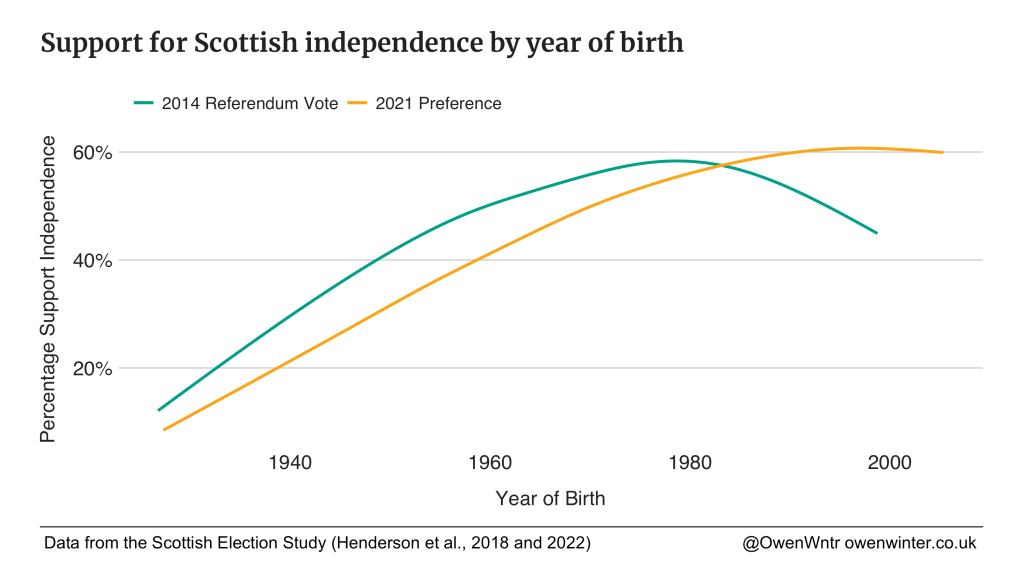
Using the SES waves from immediately after the 2014 Referendum and during the 2021 Scottish Parliament election, we can compare the age profile of Scottish independence voters then and now.
If support for independence was truly dictated by cohort effects, we should expect that support for it would stay relatively stable by year of birth. Instead, support for independence has fallen a fairly consistent amount for all voters born between 1940 and 1975 (aged 46-81 in 2021). Meanwhile it has risen among those born since 1985.
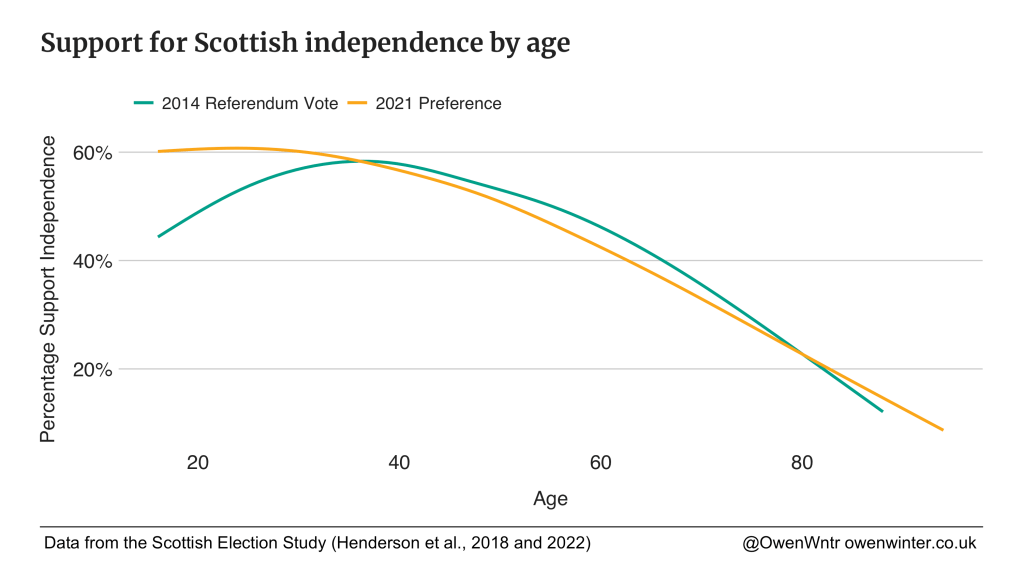
Looking by age, by contrast, a cohort effect would imply a changing distribution of voters by age, as pro-independence young people get older. Instead, support for independence by age has stayed practically identical among voters over 35. This implies that age is the more significant factor affecting preferences.
None of this is to say that independence is not possible. Polls have consistently shown a rise in support for independence since 2014, most driven by a rise in support among younger voters. Pro-independence politicians have continued their electoral dominance and there’s little evidence of a coherent unionist opposition emerging. But if independence is to occur via a successful referendum, it will be because of persuasion rather than an inexorable demographic process.
This possibly explains Nicola Sturgeon’s urgency pushing for another referendum. Even if support for independence is not overwhelming now, there is no guarantee it will increase in future. Indeed, with the SNP having been in government in Edinburgh for 15 years, combined with the possibility of Labour winning in Westminster, Scottish voters’ enthusiasm for the SNP and disgust with Westminster is by no means certain to continue indefinitely.
 Owen Winter
Leave a comment