
This research was originally posted as an LSE Politics and Policy blog post, here.
Across England, hundreds of wards in the local elections had only one ‘progressive’ candidate (Labour, Liberal Democrat or Green). I have tried to estimate the effect that this had on their vote shares, using a technique called “Coarsened Exact Matching” (CEM).
With any analysis of election results, there is a risk of omitted variable bias. CEM is one way to try and find the true “causal effect” of a variable. CEM is relatively intuitive: it is a way of comparing data which is almost exactly identical in all regards aside from the effect we are testing. Data is ‘coarsened,’ so continuous variables can be placed into categories, and data points which are an exact match are compared. In this research, the data is matched by 2018 vote share of the Conservatives, Labour, Liberal Democrats, Greens, independents, UKIP and ‘others’; the percentage of residents born in the UK, retired, white, not deprived, who live in privately rented accommodation, and who have no qualifications.
For each variable, the data is coarsened into 10% categories (0-10%,10-20% etc). For example, in Norton Canes ward in Cannock Chase, Labour was the only progressive party standing in 2022. Norton Canes was a narrow Labour win vs Conservative in 2018, is over 90% white and less than 10% of people privately rent. The results in Norton Canes are compared against Codnor and Waingroves in Amber Valley, Whitton in Ipswich and Wakefield West in Wakefield. Each of these wards were a narrow Labour win vs Conservative in 2018, over 90% white and less than 10% private rent but in these three wards the Liberal Democrats and Greens also fielded a candidate.
This does not necessarily mean there was a formal deal in place, in many areas the parties would simply be unable to find a candidate to stand, but it shows the effect of a sole progressive candidate.
The results of the CEM analysis are plotted below. The chart shows the average predicted vote share for parties with and without a single progressive alliance candidate. For Labour, the Liberal Democrats and the Green Party, this means the wards where they were the single candidate. For the Green Party, the sample size is too small for matching using 10% categories so they are extended to 20%. This means the Green result should be taken as indicative rather than an accurate causal estimate.
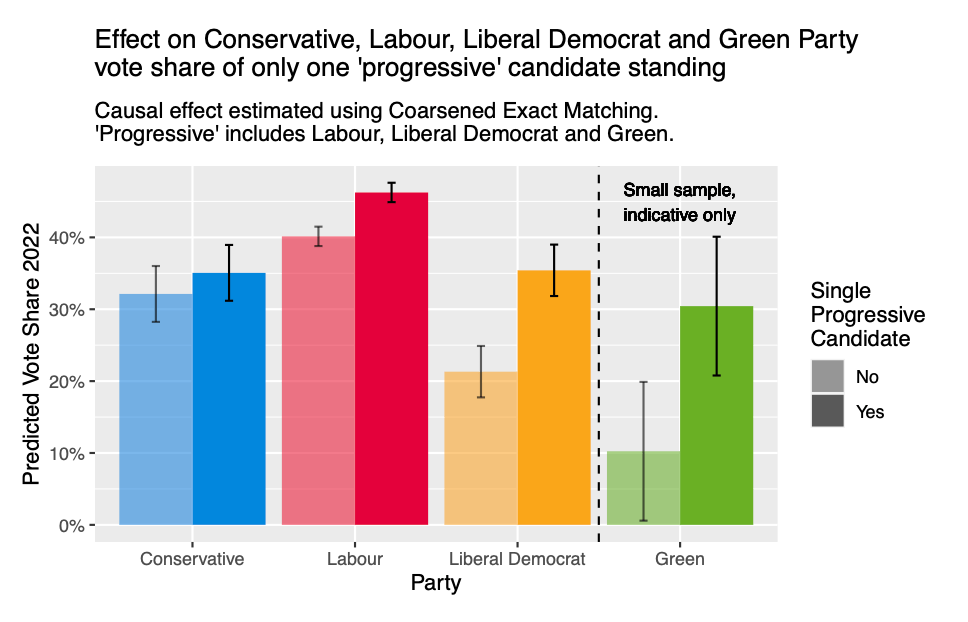
These results show the significant effect on vote share that having a single progressive candidate had. For Labour, this is estimated to increase vote share by 6.1%, while for the Liberal Democrats the effect is 14.1%. Meanwhile, the estimated effect on the Conservative vote share is an increase of 2.9%. This implies that a significant majority of voters for progressive parties will transfer to other progressive parties if their preferred party does not stand a candidate. Given that many wards are won by narrow margins, the effect of sole progressive candidates is likely to have affected the results of hundreds of elections this year.
These statistics should not necessarily be applied to other elections directly. With low turnout, local election electorates are not representative of the general public. Local election voters are likely to be “high engagement” and therefore more likely to transfer predictably between progressive parties. Local elections are also more heavily dependent on on-the-ground campaigning, so the redirection of resources afforded by standing down candidates will likely yield more significant effects. On the other hand, the increased (negative) partisanship associated with General Elections might encourage more tactical behaviour from voters opposed to the Conservative government on a national level, increasing the effect of progressive stand-asides.
That said, this research shows the effectiveness of cooperation between progressive parties which could be extended beyond a handful of local elections. Voters are more likely to transfer from one progressive party to another when only one progressive candidate is standing.
Code, data and further results are available on GitHub.
 Owen Winter
Leave a comment