When it comes to political news, there is little more sensational than a prominent politician setting up a new party. Today, Alex Salmond, former First Minister of Scotland, announced he would be starting a new pro-Independence party – The Alba Party – to contest the Scottish Parliament election in May. Will it make any difference?
Before I start, I should point you to Ballot Box Scotland, who are providing incredibly detailed Scottish polling and election analysis, and Ben Walker at the New Statesman, who is modelling polls for the upcoming election. I’m sure BBS and Ben will have lots to say about the Alba Party over the course of this campaign, so I suggest you check them out.
The first instinct of most (English) readers to the news of a new pro-Independence party is probably that it will damage the SNP by splitting the Yes vote, but since Scotland uses a form of Proportional Representation, the effect of spoiler parties is very different.
Scottish Parliament elections are conducted on two ballots, a constituency ballot (using First Past the Post) for 73 local MSPs, and a regional party list ballot, which proportionally allocates 56 MSPs to make the overall result as proportional as possible. Since it seems unlikely that the Alba Party will contest local constituencies, the regional lists are where it really makes a difference.
Since the SNP is so dominant in the constituencies section, winning 59 out of 73 seats in 2016, the party wins few regional list MSPs (4 in 2016). Current polling suggests the SNP will continue to dominate the constituency section. The SNP’s constituency position is so strong, in fact, that the proportional regional lists are unable to correct the overall result to be fully proportional.
This is where the Alba Party could cause trouble. If a significant number of Independence supporters vote SNP on their constituency ballot, but Alba Party on the regional list, the SNP will continue to win their constituency seats, but the Alba Party may be able to pick up a number of list MSPs.
Here, a small number of votes stand between the Alba Party having no impact at all and wreaking havoc. Ben Walker has approximately modelled the number of votes needed for the Alba Party to win a seat in each region, here:
Another way to look at it is to see what would have happened if the Alba Party had stood in 2016. This is a very approximate measure, given the changing political winds since 2016, but by giving The Alba Party a varying percentage of list votes from the SNP, we can begin to see the possible effect:
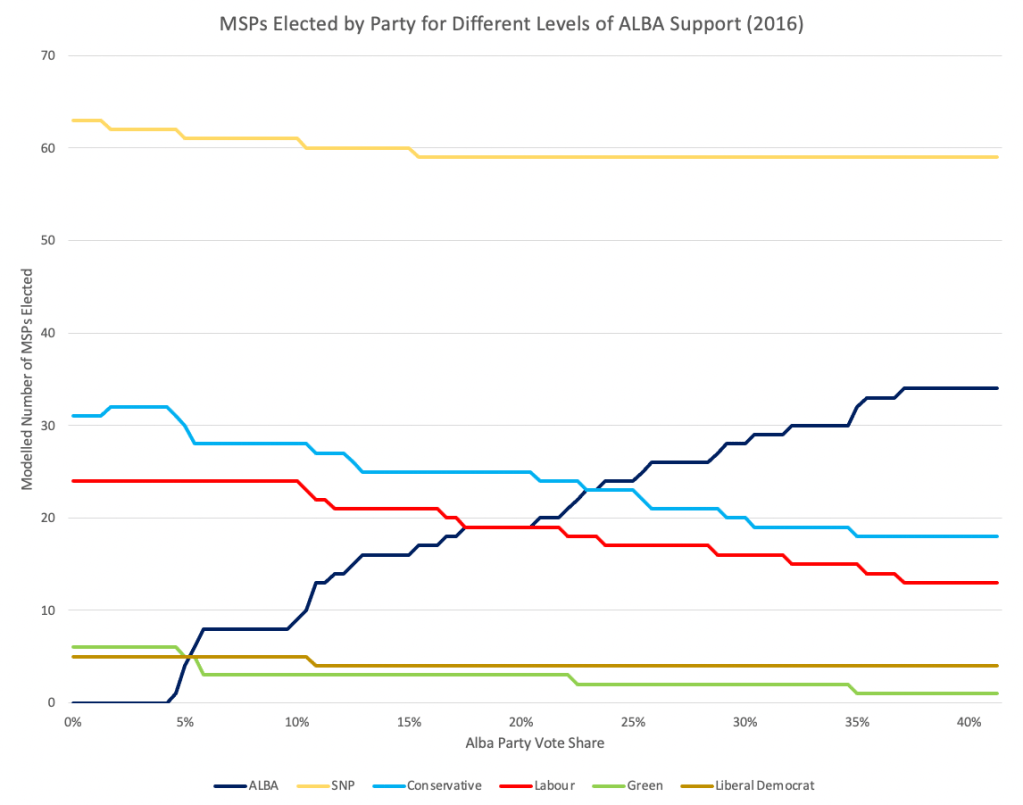
If the party wins less than 5% of the vote (which is equivalent to 12% of SNP voters defecting), it gets no MSPs and the effect on other parties is minimal (the Conservatives gain one at the SNP’s expense). If the party wins 10% however (24% of the SNP vote), it begins to make significant gains, mostly at the expense of Labour, the Greens and the Conservatives.
The net effect of a successful Alba Party would be a significantly more pro-Independence Scottish Parliament overall, as the SNP keeps its 59 constituency MSPs, joined by a group of Alba Party list MSPs. The Yes/No balance is illustrated below:

These modelled numbers depend on constituency vote shares staying the same, and Alba Party supporters being drawn perfectly from the SNP with no other votes changing, so it is not useful for predicting seats in 2021, but it is an illustration of the disruptive effect the Alba Party could have if it wins more than 5% of the vote.
However, going from a standing start to 5% of the vote in 6 weeks is a very tall order. It has never been achieved in the Scottish Parliament’s history. Excluding the 1998 elections, the best result for a new party was in 2003, when the Scottish Senior Citizens Party won 1.5% and managed to scrape 1 MSP in Central Scotland, where it won 6.5% of the vote.
With Alex Salmond’s high name recognition, it seems possible that the Alba Party could pull off a similar result, winning a single digit percentage of votes and number of MSPs. If Salmond stands as a list candidate, his personal vote might be enough to win him a seat, in a similar vein to Margo McDonald in 2003, re-elected in 2007 and 2011, but at this point it is worth pointing out how unpopular Salmond is.
As Opinium’s Chris Curtis writes, the former First Minister’s net favourability (favourable – unfavourable) is at a catastrophic -60% among Scottish voters. Even among Yes voters, only 22% have a favourable view of him. Given the Alba Party is likely to be the Alex Salmond Party in practice, this suggests a ceiling of support around 10%. Without the campaigning infrastructure of the established parties, it may be hard even to get this 10% to turn out.
While some have talked about Yes voters tactically supporting the Alba Party despite Salmond, to deliver independence, I think this is unlikely to make a significant difference. As Ballot Box Scotland’s Allan Faulds has argued in the past about the Scottish Greens, the effect of people trying to game the Scottish Parliament’s electoral system is probably overstated. Most people are just not so plugged in to the trials and tribulations of the D’Hondt formula.
I would guess that pollsters are currently scrambling to ask Scottish voters about the Alba Party, so we may have more evidence to consider its potential soon, but with a flurry of news coverage in the next few days, poll results may just be a flash in the pan (anyone remember The Independent Group polling at 18%?). The best bet is to wait and see.
 Owen Winter
Leave a comment