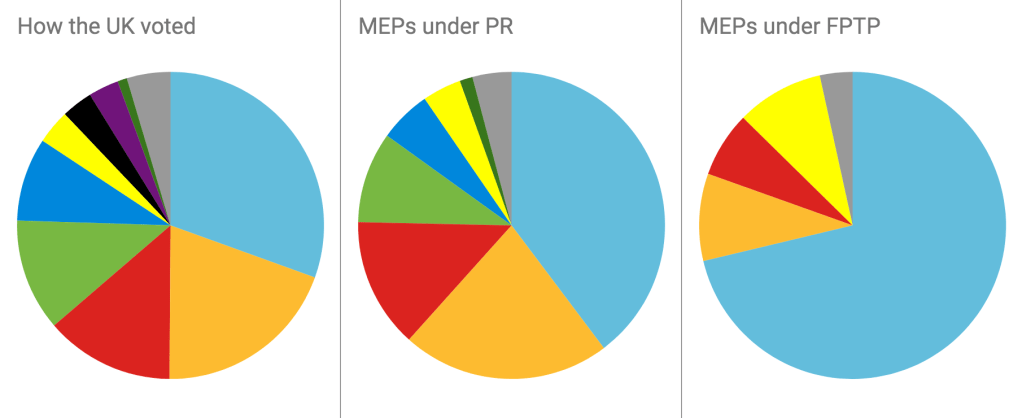
The European Elections are the only nationwide UK elections held under a form of Proportional Representation. Admittedly, due to the D’Hondt counting system and small regions, the system isn’t perfectly proportional, but it is a vast improvement on the previous FPTP system, used until 1999.
The last European Election to be held under First Past the Post was in 1994. Labour won a huge majority of MEPs (71%) with a minority of the vote (43%). After a similarly distorted General Election in 1997, Tony Blair made good on his pre-election promise to reform the system for electing MEPs – whilst leaving the House of Commons unreformed.
In 1999, the first proportional European Elections were held in the UK, bringing us into line with every other EU member state. The Green Party and UKIP won representatives for the first time and the Lib Dems gained 8 MEPs. For the first time, our European delegation reflected how people had voted.
So what if we still used the old system?
I’ve used an (admittedly crude) method to work out 2019’s European Election results under the FPTP system used in 1994, matching local authority counting areas to corresponding MEP constituencies. For the 1994 elections, Great Britain elected 84 MEPs, rather than 70, so the results don’t make perfect comparisons. But the difference is still very stark.
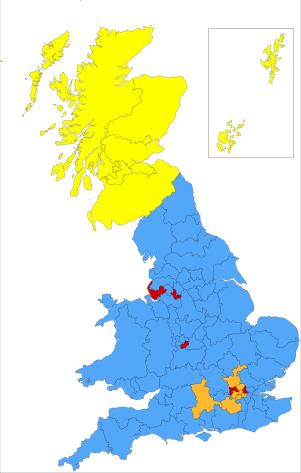 Brexit – 62
Lib Dem – 8
SNP – 8
Labour – 6
The constituencies which vote Lib Dem are Hampshire North and Oxford, Hertfordshire, London Central, London North, London South Inner, London South West, London West and Surrey.
The constituencies which vote Labour are London North East, Birmingham East, Greater Manchester Central, London North West, Merseyside East and Wigan and Merseyside West.

 Owen Winter
Leave a comment