This essay was written for the quantitative methods component of my comparative politics module.
A PDF of the essay is available here, R code is available here, and replication data is available here.
With the challenges of climate change, globalisation and a backlash against established political and economic institutions, many political commentators have pointed to a sense of alienation and marginalisation stemming from a loss of economic control. To tackle political alienation, many have argued for the extension of ‘economic democracy’ – granting people greater control over the economic forces which affect them. In this context, researchers at the University of Glasgow and Nottingham Trent University have constructed an international Economic Democracy Index (EDI) to explore the relationship between economic democracy and key public policy goals (Cumbers et al, 2016). In this essay, I will argue that countries’ electoral systems have a significant effect on levels of economic democracy.
Thesis
My thesis is that proportional democracies will have higher levels of economic democracy than disproportional ones. This is the result of three factors. Firstly, the partisanship of governments in proportional versus disproportional democracies. Secondly, the nature of decision making in proportional versus disproportional legislatures. And thirdly, the information environment and sophistication of proportional versus disproportional political systems.
The language of economic democracy is most common amongst politicians and parties of the left. These parties have greater links to trade unions, are generally in favour of higher rates of government expenditure and are more likely to support employment protection measures. It follows, therefore, that countries with greater representation of the left in government will have higher EDI scores. As Torben and Iversen (2006) argue, the nature of proportional electoral systems leads to greater frequencies of left-leaning governments. Their model – based on the class coalitions which emerge under different electoral systems – is supported by empirical data on partisanship from advanced democracies. They also argue that left-leaning parties under majoritarian systems will be most effective when they convincingly adopt a centrist (middle-class) platform, perhaps explaining why many left-leaning parties have embraced privatisation. More proportional systems, therefore, give a partisan advantage to parties which are more likely to introduce elements of economic democracy, whereas majoritarian systems disincentivise more radical proposals.
Further, proportional legislatures are themselves more likely to produce policies which expand economic democracy. This is because proportional legislatures are a ‘collective veto point’ and better at representing diffuse interests (Birchfield and Crepaz, 1998). Economic democracy involves disseminating economic power, meaning policies which are bound to be supported by a more diffuse group than its opponents. Collective veto points also encourage collective agency and reduced partisanship, leading to greater willingness to devolve political power. Single-party majority governments may, for example, be more reluctant than coalitions to devolve funding to local government units controlled by other parties. A recent example of this effect in the UK is Conservative Transport Secretary Chris Grayling’s opposition to London rail devolution, for fear it would put routes ‘in the clutches of a Labour mayor’ (Mason, 2016).
Thirdly, electoral systems affect the information environment of political systems. As Orellana (2010) argues, more permissive electoral systems allow a greater diversity of perspectives in the policy-making process, facilitating elite and public consideration of new issues and ideas. This is backed up by literature on political sophistication which argues that greater national and local competition between parties under PR systems lead to more sophisticated and engaged voters (Jackman, 1987; Jackman and Miller, 1995; Gordon and Segura, 1997). An example of broader political debate under a PR system leading to greater economic democracy is identified by Cumbers (2012), who argues that the proportional electoral system of Norway is a key factor in the debate around oil developments. Broader debate, according to Cumbers, produced radical policy proposals including the creation of the Petroleum Directorate to oversee state management of oil and gas, and legislation to ensure a slow and controlled rate of extraction. This led to an oil industry which was far more democratic than, for example, the UK’s.
These factors are the theoretical basis for the thesis that proportional democracies will have higher levels of economic democracy, a proposition I will test below.
Operationalising key concepts
Economic Democracy The Economic Democracy Index (EDI) is based on four dimensions: workplace and individual economic rights, associational economic democracy, the distribution of economic decision-making powers, and transparency and democratic engagement in macroeconomic decision-making. So far, EDI scores are available for 32 of the 34 OECD nations based on data up to 2013. The country with the highest EDI score is Denmark (0.653) and the lowest is Slovakia (0.269).
Electoral System The main measure of electoral systems I will use in this is essay is disproportionality. I use an average of Gallagher’s Least Squares Index of disproportionality for elections in each country since 1988, the 25 years leading up to 2013 (Gallagher, 2018). The mean value is 6.388, the minimum is 1.003 (Netherlands), and the maximum is 17.995 (France). I also use a dummy variable to show electoral system groups. This dummy variable assigns 1 to those countries with systems of proportional representation – from the Netherlands, the most proportional, to Hungary, the least – and 0 to non-proportional systems, including FPTP in use in the UK, Canada and USA; majoritarian systems in Australia and France; and parallel systems in Japan, South Korea and Italy.
Control Variables The control variables I use are population in thousands and the Human Development Index.
The effect of disproportionality on Economic Democracy
Despite a limited number of cases measured by the EDI, my regression analyses support the thesis that countries with more proportional electoral systems will have greater levels of economic democracy. Table 1 shows four OLS regression models with EDI as the dependent variable.
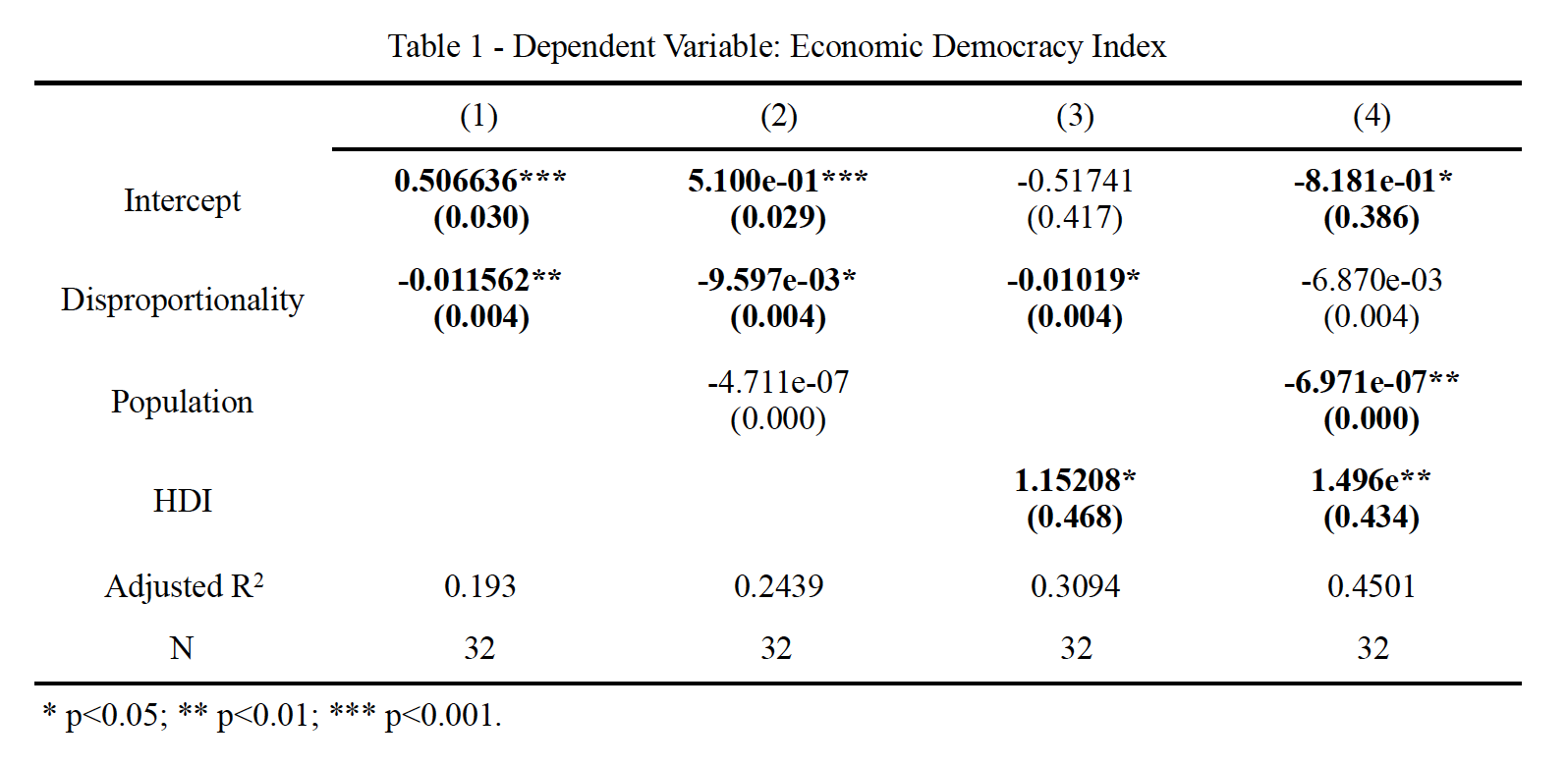
For models 1-3, disproportionality has a significant correlation with EDI, with coefficients ranging from -0.011562 to -0.009597. For an increase in disproportionality of 4.452 (the interquartile range of disproportionality data), we can expect a reduction in EDI of between 0.0435 and 0.0525 – over 10% of the total range of EDI scores. In model 4, controlling for HDI and population, the p-value is 0.061, placing it just outside the range of statistically significant results, with a coefficient only slightly smaller than models 1-3. The lack of statistical significance, in this case, is probably due to overfitting, with four predictive variables being applied to 32 cases – violating the ‘one in ten rule’ put forward by some statisticians. In models 3 and 4, we can see that HDI is the variable which produces the greatest effect on the model, necessitating further research beyond the scope of this essay.
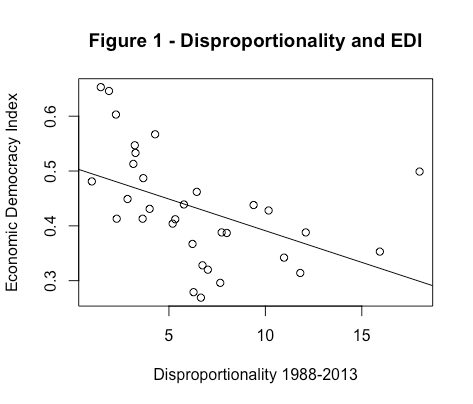
Figure 1 plots EDI versus disproportionality, with model 1 illustrated. This graph shows one obvious outlier – France – which has the highest disproportionality of any of the countries in my model. It is worth noting that removing France increases both the significance and size of the relationships identified in Table 1.
Transforming the Independent Variable
Looking at Figure 1, we can see that a non-linear model may be more appropriate to consider the relationship. This is because the effect of disproportionality on EDI reduces as disproportionality increases. Whereas the first few percentage points of disproportionality make a big difference to the political system of a country – changing the electoral permissiveness and altering the party system (Neto and Cox, 1997); once a certain level of disproportionality is reached, an electoral system can effectively be described as ‘majoritarian’. By transforming the independent variable – disproportionality – we can more appropriately model its effect on EDI.
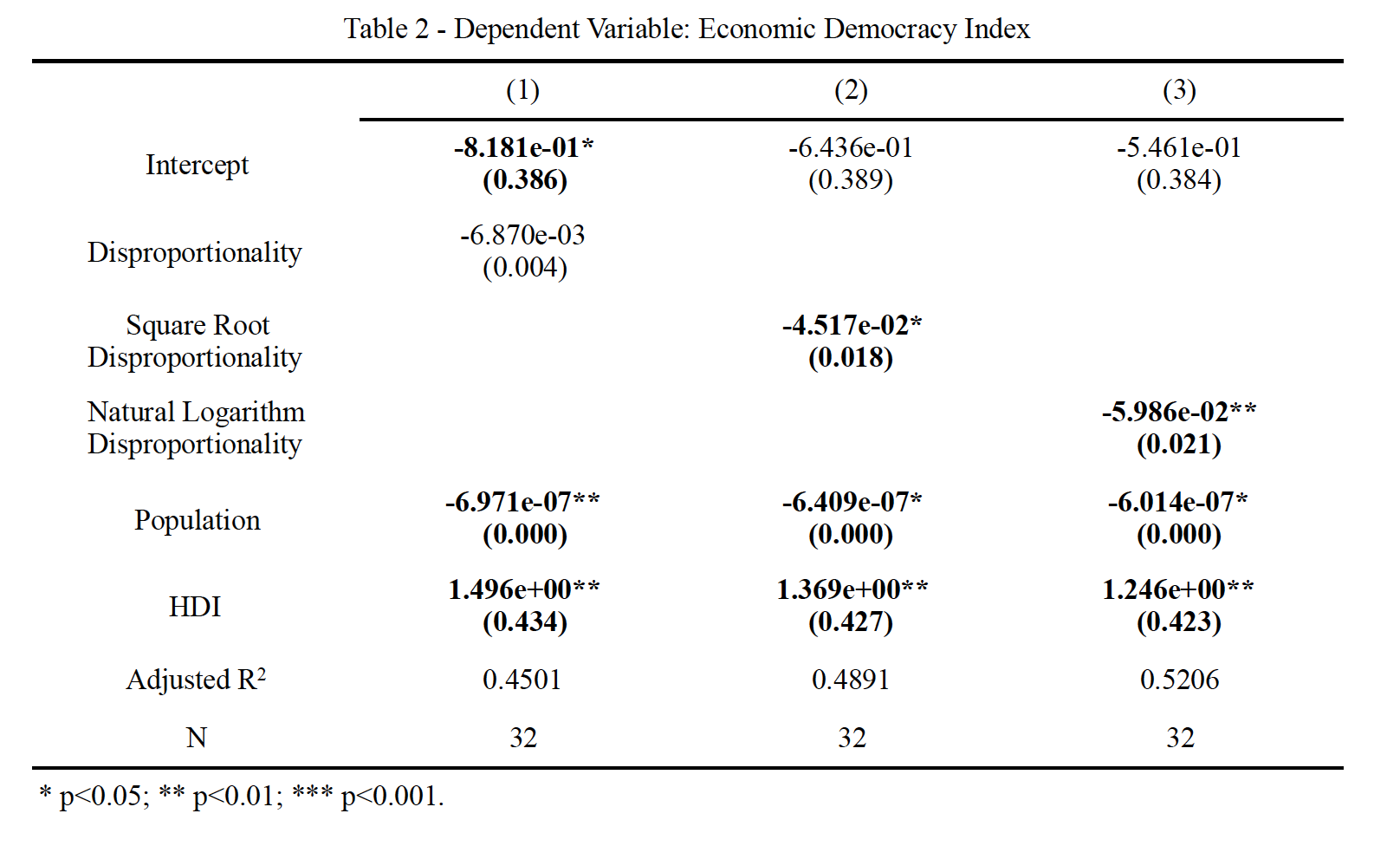
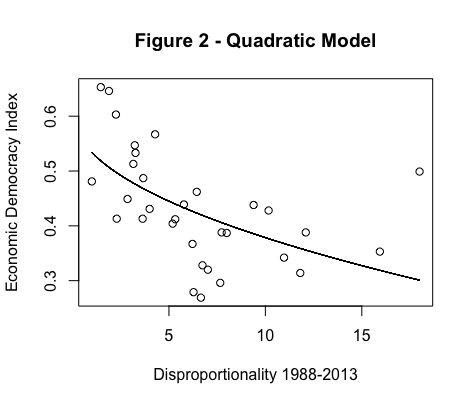
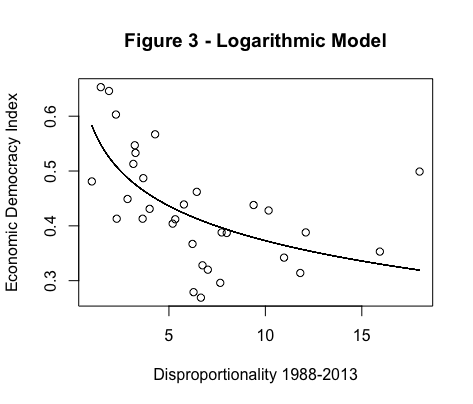
Table 2 shows how the square root or natural logarithm of disproportionality are both better models for explaining variation in economic democracy when controlling for population and development. These transformations marginalise the large differences in disproportionality amongst disproportional democracies, as opposed to the relatively small variations in proportional ones. Figures 2 and 3 show how the transformed model maps onto disproportionality versus EDI.
Disproportionality within electoral system groups
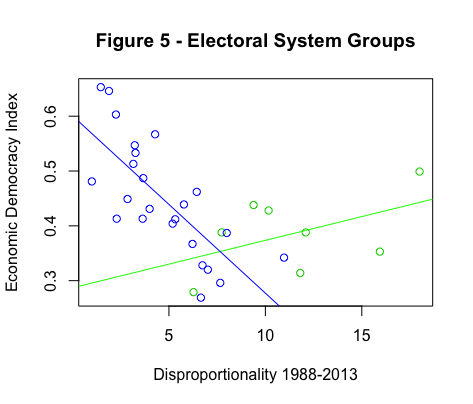
We can also look at the effect of disproportionality within electoral system groups, using a dummy variable. Figure 4 shows the effect of disproportionality on economic democracy in non-PR countries (0), versus PR countries (1). As we can see, the correlation is entirely reversed within the non-PR group. With an N value of 8 in the non-PR group, it is not possible to find a statistically significant correlation, so it is likely that this coefficient is driven by the outlying positions of France – with very high disproportionality and relatively high EDI – and the USA – with very low EDI and surprisingly low disproportionality, owing to the extensive use of primary elections and very strong two-party system.
By contrast, there is a statistically significant relationship within the PR electoral system group, even when controlling for population and development. We can see this correlation in Figure 5, with PR countries coloured blue and non-PR countries green.

Discussion of the results
The results above are consistent with the thesis that greater electoral proportionality is correlated with greater economic democracy. When controlling for population and development, significant correlations can be found between EDI and the square root or natural logarithm of disproportionality.
The results also show that the effect of disproportionality on EDI is strongest amongst more proportional countries. This suggests that flawed PR systems, such as those used in Hungary, Poland and Greece, can be considered to be ‘majoritarian’ in their effect on political outcomes. Once a certain level of disproportionality has been reached – erecting barriers to participation – the level of disproportionality becomes insignificant.
France emerges as a notable case due to its high disproportionality. France’s relatively high EDI score probably owes to high government spending as a percentage of GDP and a relatively small share of total tax revenue going to central government. France is the only country studied in this essay to use the two-round electoral system. France’s weak two-party system and use of proportional voting in local government are areas to be considered in further research on electoral systems and economic democracy.
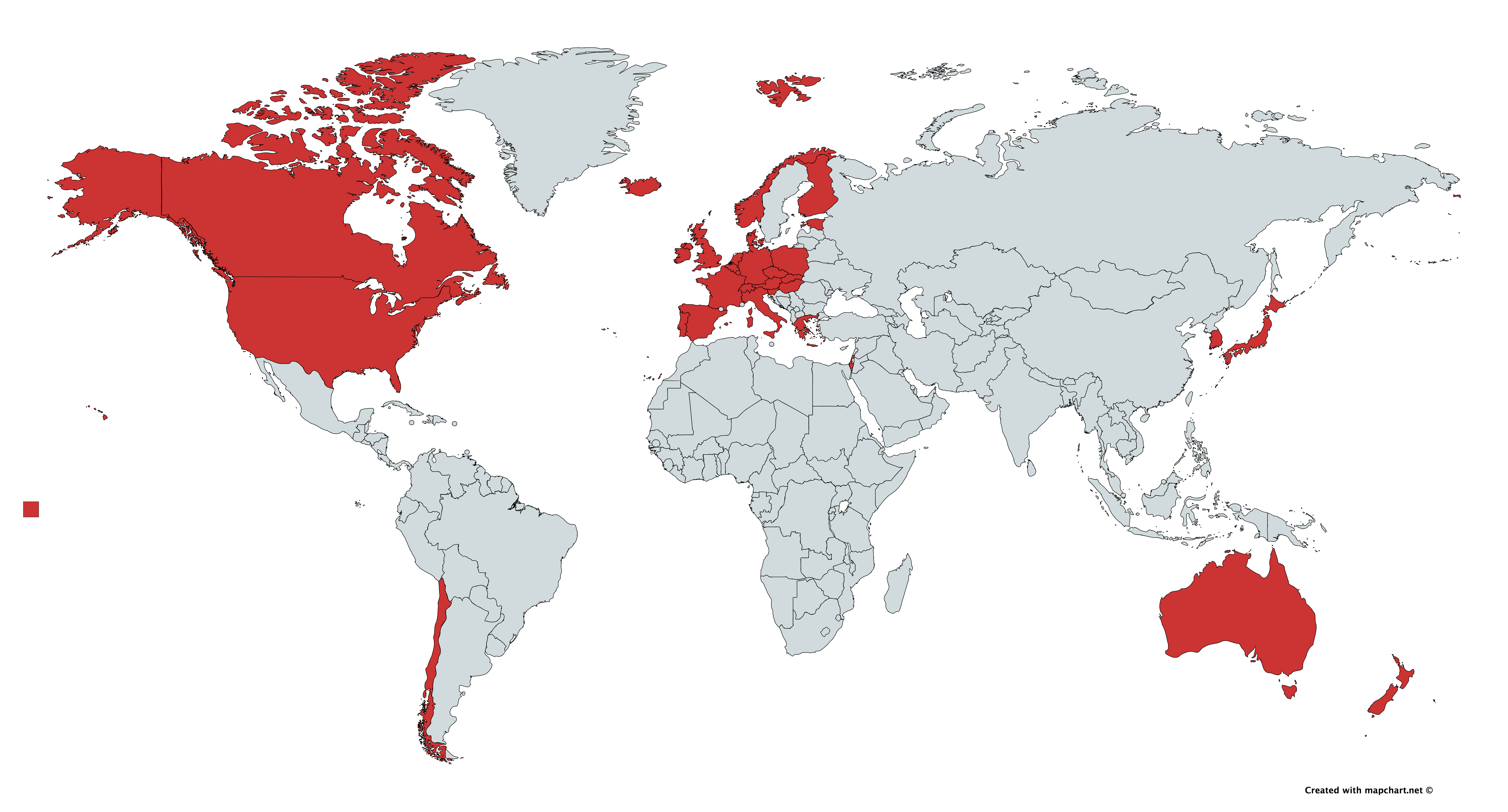
These results show the need for further investigation. Figure 6 shows the cases studied in this dataset, exposing the lack of non-Western cases and the dominance of European countries. As the EDI is only available for members of the OECD, there is also a lack of less economically developed countries – especially important given the strength of the effect of development identified in Table 1. There is also a lack of disproportional systems represented – with only 8 cases out of 32 using non-PR systems. By increasing the number of cases studied, we could avoid the problem of overfitting.
Figure 6 – Map of Cases Studied
Finally, it is important to consider problems of endogeneity. It could be, as theorised by Rokkan (1970) and Boix (1999), that countries with strong socialist parties adopted PR as a means of defending bourgeois interests, whereas those with weak socialist parties or united conservative parties retained majoritarian systems. This is consistent with some evidence showing a negative correlation between disproportionality and trade union density. This could be a confounding variable, with socialist movements leading to both economic democracy and electoral reform. This reinforces the need to expand the number of cases studied, which would allow for the introduction of further control variables. However, the number of variables considered as part of the EDI mean multicollinearity may be an issue.
Conclusion
Through a combination of government partisanship, with greater representation of left-of-centre parties in government; collective decision making, leading to reduced partisanship; and diversity of political debate, leading to greater political sophistication and consideration of new ideas; proportional democracies are better placed to introduce elements of economic democracy than disproportional ones. This is backed up by strong and significant correlation coefficients between disproportionality and EDI, especially when disproportionality is transformed polynomially or logarithmically. This evidence also suggests that it is the level of disproportionality – rather than electoral system group – which affects levels of economic democracy, with flawed PR systems performing similarly to majoritarian systems. Further research is needed to test this relationship in less economically developed and Western countries, as well as to confirm the direction of causality.
References Used
Birchfield, V. and Crepaz, M. (1998), “The impact of constitutional structures and collective and competitive veto points on income inequality in industrialized democracies”, European Journal of Political Research, Vol.34(2), pp.175-200
Cumbers, A. (2012), Reclaiming public ownership: Making space for economic democracy, London and New York, Zen Books
Cumbers, A. et al (2016) ‘Preliminary findings from the Economic Democracy Index’, Democratising the Economy, 14 November. Available at: https://democratisingtheeconnomy.wordpress.com/2016/11/14/preliminary-findings-fromthe-economic-democracy-index/ (Accessed: 23 December 2018)
Crepaz, M. (1996), “Constitutional structures and regime performance in 18 industrialized democracies: a test of Olson’s hypothesis”, European journal of political research, Volume 29, pp.87-104
Gallagher, M. (2018) ‘Electoral systems’, Trinity College Dublin, 27 March. Available at: https://www.tcd.ie/Political_Science/people/michael_gallagher/ElSystems/index.php (Accessed: 2 December 2018)
Gordon, S. and Segura, G. (1997) ‘Cross-National Variation in the Political Sophistication of Individuals: Capability or Choice?’, The Journal of Politics, Vol. 59(1), pp.126-147
Iversen, T. and Soskice, D. (2006) ‘Electoral Institutions and the Politics of Coalitions: Why Some Democracies Redistribute More Than Others’, American Political Science Review, Vol.100(2), pp.165-181
Jackman, R. (1987) ‘Political institutions and voter turnout in the industrial democracies’, The American Political Science Review, Vol.81(2), pp.405-423
Jackman, R. and Miller, R. (1995) ‘Voter turnout in the industrial democracies during the 1980s’, Comparative Political Studies, Vol.27(4), pp.467-492
Mason, R. (2016) ‘Rail letter leak: Chris Grayling accused of putting politics over people’, The Guardian, 7 December, Available at: https://www.theguardian.com/uk-news/2016/dec/07/chris-grayling-accused-of-putting-politics-over-people-in-rail-letter-leak, (Accessed: 23 December 2018)
Orellana, S (2010) ‘How Electoral Systems Can Influence Policy Innovation’, Policy Studies Journal, Vol.38(4), pp.613-628
Background References
Benoit, K. (2007), “Electoral Laws as Political Consequences: Explaining the Origins and Change of Electoral Institutions”, Annual Review of Political Science, Vol.10(1), pp. 363-390
Birchfield, V. (2000), “Political justice versus market justice: Explaining variation in income inequality among consensus and majoritarian democracies”, ProQuest Dissertations Publishing, University of Georgia
Boix, C. (1999), “Setting the rules of the game: The choice of electoral systems in advanced democracies”, The American Political Science Review, Vol. 93(3), pp. 609-624
Bormann, N.C. (2010), “Patterns of Democracy and its Critics”, Living Reviews in Democracy, Volume 2
Clark, W.R., Golder M., and Golder S. (2009), Principles of Comparative Government, Third Edition, Washington, SAGE/CQ Press
Dahl, R. (1971), Polyarchy: participation and opposition, New Haven and London, Yale University Press
Duverger, M. (1951), Les Partis Politiques, Paris, Librairie Armand Colin
Fortin, J. (2008), “Patterns of Democracy? Counterevidence from Nineteen Post- Communist Countries”, Zeitschrift für Vergleichende Politikwissenschaft, Volume 2(2), pp.198-220
Golder, M. (2005), “Democratic electoral systems around the world”, Electoral Studies, Vol. 24(1), pp.103-121.
Lijphart, A. (1990), ”The political consequences of electoral laws”, American Political Science Review, Vol. 84(2), pp.481-496
Lijphart, A. (2012), Patterns of Democracy, 2nd Edition, New Haven and London, Yale University Press
Lipset, S. and Rokkan S. (1990), “Cleavage structures, party systems and voter alignments: an introduction”, in Mair P. (ed.) The West European Party System, Oxford, Oxford University Press
Nagel, J.H. (2000), “Expanding the Spectrum of Democracies: Reflections on Proportional Representation in New Zealand”, In M. Crepaz, T. Koelble & D Wilsford (Eds.) Democracy and Institutions – The Life Work of Arend Lijphart, University of Michigan Press, pp.113-128.
Neto, O., and Cox, G. (1997) “Electoral Institutions, Cleavage Structures, and the Number of Parties”, American Journal of Political Science, Vol. 41(1), pp.149-174
Rae, D. (1971), The political consequences of electoral laws, New Haven, Yale University Press
Rokkan, S. (1970), Citizens, elections, parties: approaches to the comparative study of the processes of development, Oslo, Universitetsforlaget
Tsebelis, G. (2011), Veto Players: how political institutions work, Princeton, Princeton University Press
 Owen Winter
Leave a comment