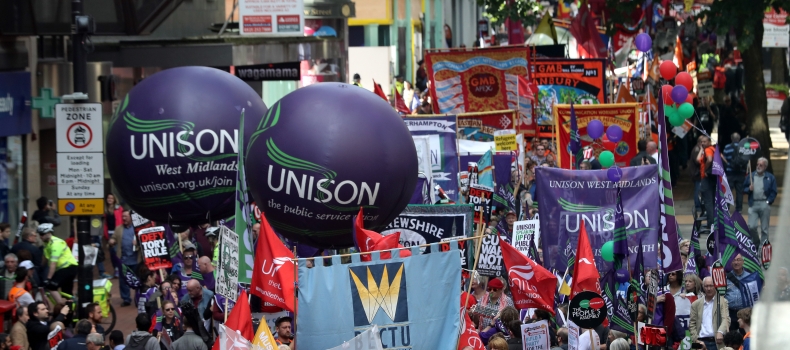
I wrote this pamphlet for Make Votes Matter‘s trade union campaign, February 2019 – PDF available here.
Introduction
The idea that social equality, and a fair deal for workers, is deeply linked to political representation has always been central to the trade union movement. From the Peterloo Massacre, 200 years ago this year, to the Chartists, to the foundation of the Labour Party – working people have always understood that political equality is the only way of wresting economic power from the wealthy.
This pamphlet makes the case that trade unions should support changing the voting system to Proportional Representation (PR). PR would mean a better democracy, a better environment for trade unions to represent workers, and a fairer society. Although some unions have previously opposed PR, the tide is turning. It’s time for ordinary trade unionists to push their unions to support a better voting system.

First Past the Post is bad for…
Democracy
The current First Past the Post (FPTP) voting system leads to parliaments which fail to reflect most people. Because of the distorting effect of single-member constituencies, governments are frequently elected on a minority of the vote. Just look at our current government, made up of the Conservatives who won 42% of the vote, propped up by the DUP who won only 1%.
In fact, FPTP doesn’t even guarantee that the party with the most votes wins. Take 1951, for example, when Labour won its highest share of the vote ever, beating the Conservatives by over 200,000 votes, but winning fewer seats and being kicked out of office. FPTP means that parties which lose votes frequently gain seats, and vice versa.
Put simply: FPTP does not reflect how people vote.
Trade Unions and their Members
Not only is FPTP unfair but it also rigs our political system against the majority of people and trade unions.
Firstly, FPTP means the existence of ‘marginal’ and ‘safe’ seats. Politicians are incentivised to focus entirely on a small number of marginal seats, which may change hands, rather than designing policies for the whole country. For Labour, this is particularly damaging due to the threat of UKIP and the SNP in traditional heartlands, where these parties have effectively claimed that Labour no longer reflects its voters.
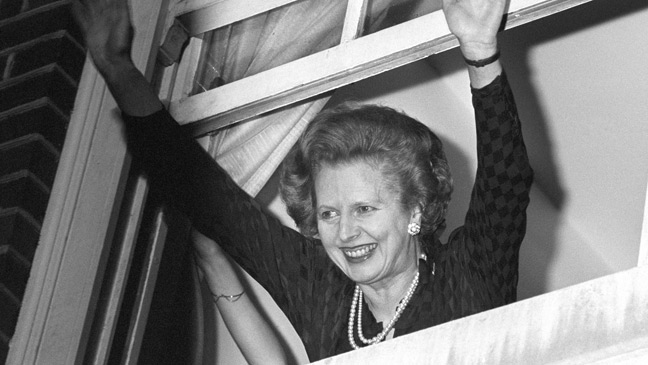
FPTP also means sudden swings between governments with almost absolute power. This has allowed governments to attack trade union rights with little opposition in Parliament, for example in the 1980s, when the landslide victory of 1983 with just 42% of the vote inspired Margaret Thatcher to launch her assault on trade unions.
The Answer is Proportional Representation
Proportional Representation (PR) simply means an electoral system in which seats in parliament broadly reflect how people have voted. If a party wins 20% of the votes, they win approximately 20% of seats under a PR system. PR is used by the vast majority of democracies around the world, including 85% of OECD nations. In the UK, we already use PR for elections to the Scottish and Welsh Parliaments, and the Northern Ireland and London Assemblies. These systems mean legislatures which reflect how people have voted, whilst retaining a constituency link for MPs to represent local areas.
PR Strengthens Progressive Politics
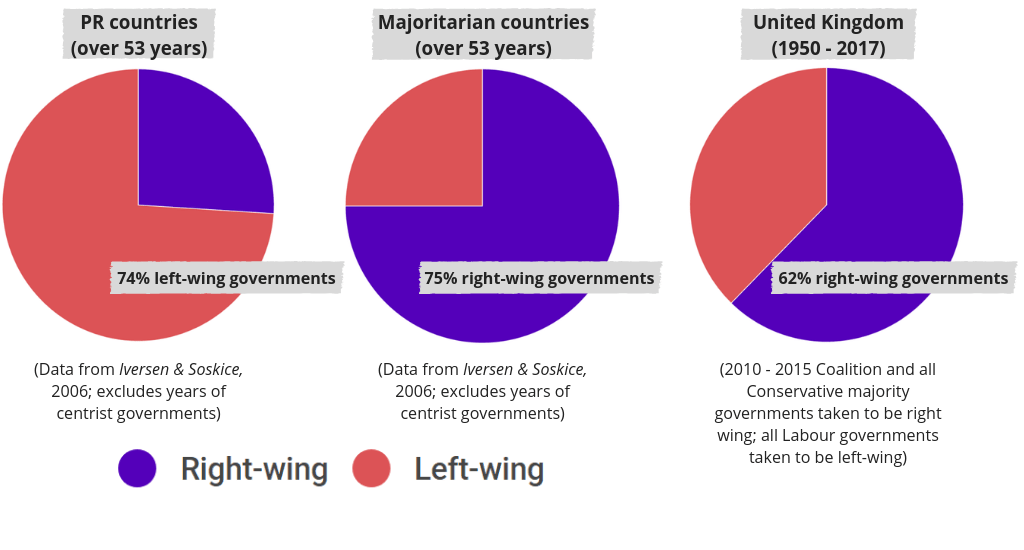
Research from academics has shown that countries with PR systems around the world tend to have left-wing governments a higher proportion of the time. Political scientists Iversen and Soskice, for example, find that over 53 years PR countries tended to have left-wing governments 74% of the time, whilst non-PR countries had right-wing governments 75% of the time. In the same period, the UK had Conservative-led governments 62% of the time.
In the UK, the situation is getting even worse, with an anti-Labour bias emerging in the electoral system. Recent research suggests that Labour would need a 7.4% lead over the Conservatives to win a majority, whilst the Conservatives need only a 3.4% lead. This would be exacerbated if the Conservatives’ boundary changes are passed. It is increasingly likely that another wrong-winner election could keep the Conservatives in power even if Labour win more votes.
In fourteen of the last fifteen general elections, a majority of voters voted for parties to the left of the Conservatives, yet the Conservatives have governed for most of this time. Although PR may not always lead to a Labour government, one thing is for sure – we never would have had Thatcher’s right-wing government with absolute power if Britain had used PR in the 1980s.

PR Means Beter Democratic Quality
Not only would PR deliver more Labour governments, but it would also mean greater democratic quality. For example, research suggests that PR systems have higher turnout. Because under PR there are no ‘safe’ seats, political parties must compete across the whole country, meaning more incentive for voters to turn out. In turn, higher turnout also leads to greater political engagement and sophistication. This could be a big opportunity for trade unions, who have struggled to recruit members in recent years.
Turnout is particularly important because the people who are least likely to turn out – younger, poorer voters and those from certain minority groups – are also those who are least represented in politics. Research suggests that PR systems are better at representing minority groups, and have greater gender balance. For example, every country with over 40% women in its primary legislature uses a form of PR.
PR Creates Equal Societies with Better Outcomes
More progressive politics and better democratic quality lead to better political outcomes. PR leads to more long-term decision making, in the interests of the whole country, rather than just those living in marginal seats or the 35-45% of people who voted for the winning party.
Political scientists have found that PR countries have lower social inequality, are more likely to be welfare states and have higher social spending. For example, the top 14 most equal societies in terms of income all use systems of PR. Other studies have shown that PR countries also adopt more environmentally friendly policies and are even less likely to go to war.
Electoral reform is about far more than just fairness or partisan advantage. It is about building a society in the interests of the many, rather than a privileged few.
The Time is Now
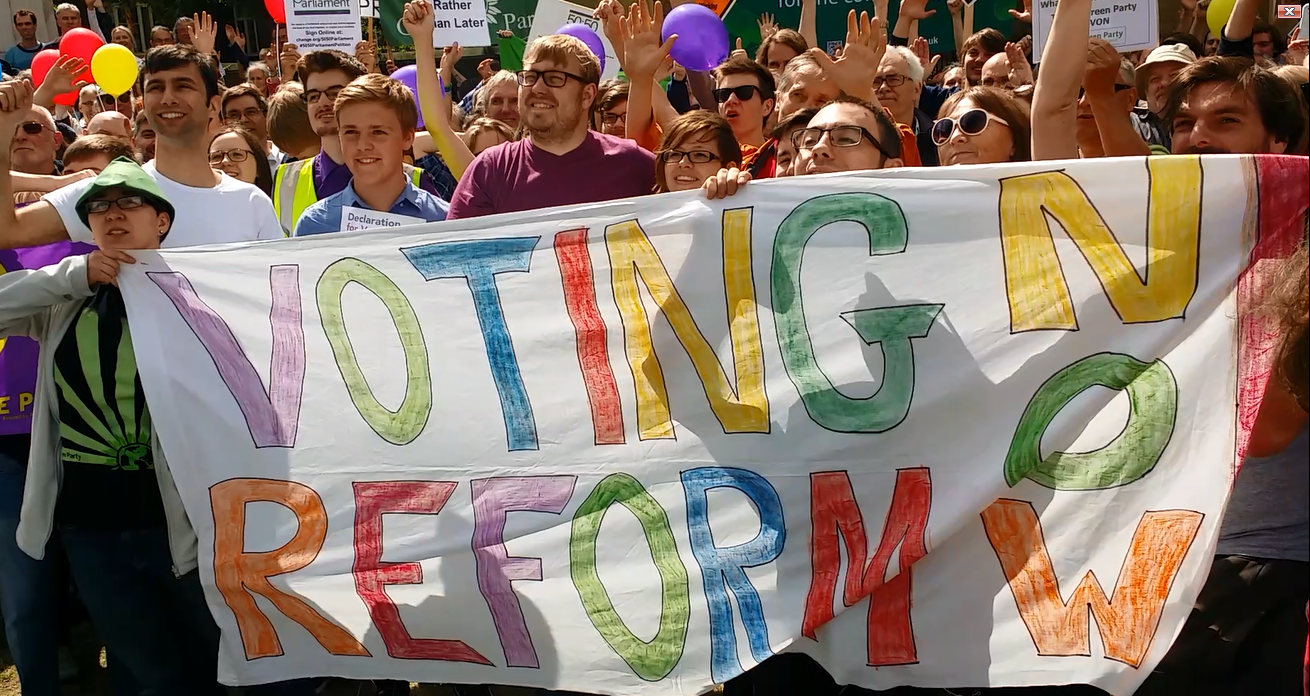
Since 2015, there has been a huge surge in support for PR. Make Votes Matter, the cross-party single-issue campaign for PR, has been building support among politicians and the public. Opinion polls have shown huge support for reform from the public. Now it is time for trade unions to get on board.
Recently, more and more prominent trade unionists, including Frances O’Grady, Mark Serwotka, Ian Lawrence and Howard Beckett, have come out in favour of PR. A group of trade unionists pushing for political reform recently formed Politics for the Many.

What can you do?
- Invite a Make Votes Matter speaker to your trade union branch by emailing labour4pr@makevotesmatter.org.uk
- Pass a motion at your local branch in favour of PR
- Ask your General Secretary or political officers what your union’s position on PR is and encourage them to call for reform
- Raise the issue at your trade union conference
 Owen Winter
Leave a comment